How to Show Up in AI Overviews, ChatGPT and Perplexity
Search has quietly crossed a tipping point. For many healthcare questions, patients no longer see a full page of blue links—they see a single, AI‑written answer that cites a handful of trusted sources. Google AI Overviews, ChatGPT, Claude, Gemini and Perplexity are deciding which brands to quote, which providers to list and which sites to ignore.
Old‑school SEO was about ranking pages. You picked a keyword, optimized a URL and tried to climb higher on the results page. Today, AI systems work differently: they scan huge parts of the web, pick a short list of trustworthy sources and then synthesize an answer—often without sending a click to your site at all. In this world, your goal shifts from “rank #1” to “be the source AI trusts enough to recommend.”
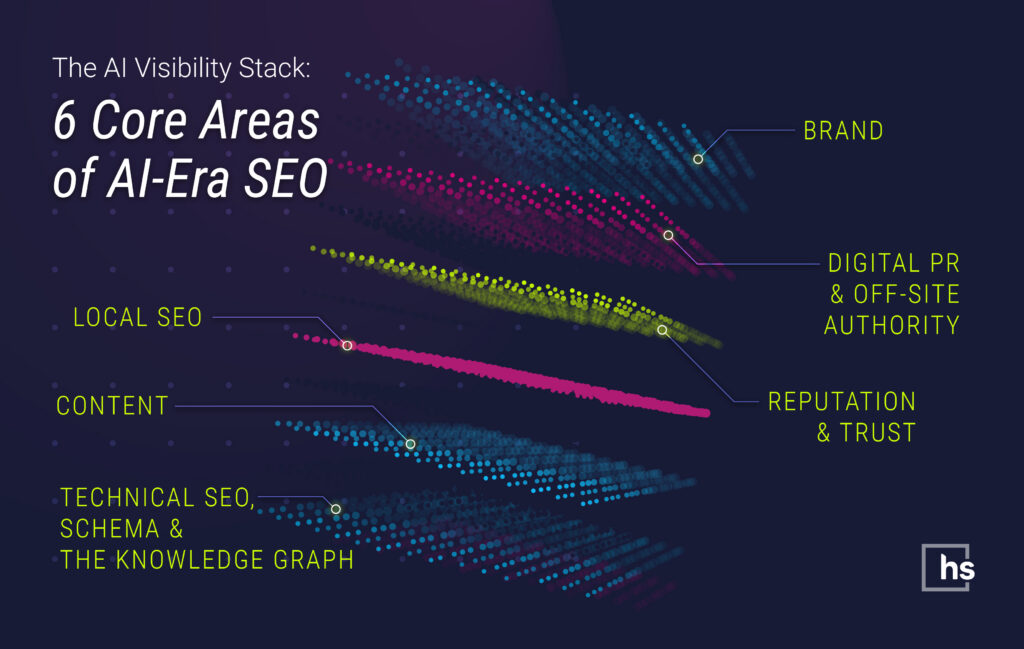
The good news is that the playbook is knowable—especially for serious healthcare brands. Across the industry, six categories of signals keep showing up: your brand strength, your content quality, your technical and schema foundation, your local presence, your reputation and your off‑site digital PR. Together, these six areas determine whether AI can understand you, trust you and confidently use you as the answer.
This article is the home base for a seven‑part series on “How to Show Up in AI Overviews, ChatGPT, Claude, Gemini and Perplexity” for healthcare brands. It introduces the AI Visibility Stack—six core areas of AI‑era SEO: brand, content, technical SEO and schema, local SEO, reputation and off‑site digital PR—then links to six deep‑dive playbooks: Brand in an AI‑First Search World, Content That AI Loves to Cite, Technical SEO & Schema for AI, Local SEO in the Age of AI, Reputation & Trust in an AI World and Off‑Site Digital PR in an AI World. Together, they’re designed so your marketing, digital and clinical leaders can work from the same framework rather than chase disconnected SEO tips.
With this series, we're introducing The AI Visibility Stack™ and how we use it to get healthcare brands consistently surfaced in AI platforms.
How AI recommendations differ from old‑school Google
Legacy SEO was built for a world of “ten blue links.” You optimized individual URLs for specific keywords, built links and watched your rankings rise or fall. That world hasn’t disappeared—but it is no longer the only, or even primary, way patients discover you.
Modern AI systems like Google AI Overviews, ChatGPT, Claude, Gemini and Perplexity behave differently in a few fundamental ways:
- They answer first, then include sources (if at all).
- They pull from multiple sources and fuse them into one narrative.
- They are much more sensitive to trust, risk and medical accuracy—especially in healthcare.
- They personalize by intent, location and context, particularly for high-risk queries.
Instead of asking, “Which single page should rank #1 for this keyword?” AI systems ask:
- Who truly understands this question and its nuances?
- Who has enough depth on this topic to be quoted safely?
- Who is clearly who they say they are (brand, organization, location)?
- Who is widely trusted and corroborated by independent signals?
That shift is why classic SEO shortcuts—thin content, keyword‑stuffed pages, commodity link building—are losing effectiveness. The game is now about being:
- Understandable (machine‑readable and well structured)
- Trustworthy (clinically and reputationally safe)
- Deep (ample context on a page or topic cluster)
- Important (backed up by the wider web and real-world signals)
The six areas below give you a practical way to operationalize that.
The AI Visibility Stack: six core areas that matter now
Think of this as an AI Visibility Stack—layers of signals which together determine whether AI can find you, trust you and feel safe recommending you:
- Brand
- Content
- Technical SEO & schema
- Local SEO
- Reputation & trust
- Off‑site digital PR
Each area is important in its own right. But the real advantage comes when they reinforce one another: Your content powers your PR, your PR strengthens your brand, your technical foundation makes everything easier to interpret, your local footprint makes you eligible for recommendations and your reputation reduces perceived risk.
Each area below has its own deep‑dive playbook in this series.
Area 1: Brand—becoming the “safe default”
When AI has to name a hospital, health system, medical group or health services firm, it will lean toward brands it recognizes, understands and sees repeatedly in trustworthy contexts. In other words, the brand has become a ranking-and-routing heuristic.
The key shift is this: Brand is not just how you’re perceived by humans anymore—it’s also how you’re “resolved” by machines. If an AI system can’t form a clean mental model of who you are, it won’t take the risk of recommending you.
What to focus on:
- Clarity of positioning: Can you answer, in one sentence, who you serve and what you’re known for—consistently across your website, leadership profiles and external listings?
- Distinctiveness: Generic positioning makes you harder to categorize; specificity gives AI something stable to map to intent.
- Branded demand: Rising branded search and consistent brand mentions across credible contexts show that real people look for you by name.
For executives, this is the bridge between traditional brand building and AI‑era visibility: The stronger and clearer your brand, the more likely AI systems are to default to you when they have to choose.
👉 Read next: Brand in an AI‑First Search World—the deep‑dive playbook for becoming the “safe default” when AI systems need to name a healthcare brand.
Area 2: Content—being the source AI wants to quote
AI does not need yet another 600‑word surface‑level blog post that restates what everyone else has already said. It’s trained on billions of pages. What it still needs—especially in healthcare—is content that reduces ambiguity, answers real follow‑up questions and is visibly accountable.
That’s why the best AI‑SEO content strategy is less about volume and more about definitive coverage:
- Fewer, deeper pages: Build strong hubs around your priority conditions and service lines rather than scattering authority across dozens of overlapping posts.
- Question‑driven structure: Use headings and FAQs that mirror patient and caregiver questions, then answer directly before adding nuance.
- E‑E‑A‑T signals: Credentials, review processes, references and clear disclaimers make content safe to reuse in high‑risk answers.
- Originality and differentiation: Publish what AI can’t confidently invent—outcomes context, real‑world examples, proprietary data, clinician POV and operational specifics.
If you want AI to recommend you, each important page should be written as though it might be the primary source paragraph in an AI answer on that topic.
👉 Read next: Content That AI Loves to Cite—the deep‑dive playbook for building definitive, citation‑ready pages around your priority service lines and conditions.
Area 3: Technical SEO & Schema—making your site machine‑readable
Technical SEO is no longer “backend hygiene.” In an AI‑first environment, it’s the eligibility infrastructure.
AI systems assemble answers from fragments—pages, passages, entities and relationships. If your site is slow, structurally unclear or inconsistent about entity relationships (organization → location → provider → service), you increase the chance AI systems will misinterpret you—or skip you in favor of a cleaner competitor.
Three priorities tend to matter most:
- Clean architecture and internal linking: Your site structure teaches machines what matters; hub‑and‑spoke linking, shallow click depth and clear URL patterns reduce ambiguity.
- Performance plus accessibility: Speed and mobile experience reduce friction and increase crawl/processing effectiveness; they’re table stakes for being usable at scale.
- Schema and structured data: Schema is the translation layer that clarifies meaning, helping systems understand content and enabling richer interpretation.
👉 Read next: Technical SEO & Schema for AI—the deep‑dive playbook for making your healthcare site machine‑readable and AI‑ready.
Area 4: Local SEO—winning “near me” and intent‑rich local queries
Many of the highest‑value healthcare searches are local by nature: urgent care, specialists, same‑day access, “best near me,” “open now,” “takes my insurance” and so on. AI Overviews and conversational systems aren’t just summarizing—they’re being asked to recommend real providers in real places, often under urgency.
To compete, you need:
- Rock‑solid Google Business Profiles (GBP) at scale (accurate categories, services, hours, attributes, photos and active management).
- Location‑specific pages that do real work (services, providers, parking/directions, insurance, localized FAQs—plus schema).
- Consistent NAP across the ecosystem (your website, GBP, directories, payer/provider finders).
- Local entity clarity in the schema so AI can connect “who does what, where.”
Local SEO boils down to one question: “If I’m going to name a provider here, who is the safest, most credible choice?”
👉 Read next: Local SEO in the Age of AI—the deep‑dive playbook for winning “best [specialty] near me” in your key markets.
Area 5: Reputation & Trust—de‑risking the recommendation
When an AI system recommends a provider, it is implicitly putting its own credibility on the line. That’s especially true in healthcare, where bad guidance can cause real harm. So AI systems become conservative: They favor entities with strong corroboration and low perceived risk.
They and their surrounding ecosystems weigh:
- Ratings and reviews: volume, recency, average rating and trendline stability
- Review text and themes: bedside manner, access, wait times, clarity of explanations, billing friction.
- Broader safety signals: credentials, affiliations, awards, governance, transparency and consistency across web properties
- Risk signals: unresolved negative patterns, scandals, regulatory actions, sustained low sentiment
That’s why reputation is now more than persuasion—it’s eligibility.
👉 Read next: Reputation & Trust in an AI‑First World—the deep‑dive playbook for becoming the low‑risk, high‑trust choice in AI‑mediated discovery.
Area 6: Off‑site Digital PR—building proof of importance
Off‑site SEO used to mean one thing: links. In 2026, links still matter—but AI‑driven discovery expands “authority” into a broader footprint:
- Editorial links from reputable domains
- Unlinked brand mentions in credible contexts
- Expert quotes and co‑citations
- Partnerships and affiliations that appear alongside your brand
- Reach signals from media, podcasts and widely shared thought leadership
Digital PR is how you create independent proof that you matter—so when AI systems scan the wider web and ask, “Is this brand truly a leader in this space?”, the answer is obvious.
👉 Read next: Off‑Site Digital PR in an AI World—the deep‑dive playbook for turning media, mentions, and thought leadership into AI‑era authority.
Where tracking and measurement fit in
Historically, SEO reporting centered on rankings, organic sessions and click‑through rate. Those metrics still matter—but they’re no longer sufficient when AI answers can satisfy intent without a click.
Over time, your measurement strategy should expand to include:
- Presence in AI surfaces (AI Overview inclusion, citations and frequency of being named)
- Branded demand and mentions (search interest for your name + service lines)
- Reputation health (review velocity, rating trends, sentiment themes)
- Engagement quality (conversion rate, appointment intent, return visits, assisted conversions)
The goal isn’t to build a perfect AI dashboard overnight. It’s to recognize that AI visibility is a distinct outcome—and to measure it deliberately as you strengthen each area of the stack.
Bringing it all together for healthcare leaders
For executives and marketers, the readiness questions are straightforward:
- Are we a clearly defined brand in the eyes of both patients and algorithms?
- Do we publish deep, structured content that AI systems can safely cite?
- Is our site technically ready and unambiguous to machines?
- Are we eligible to win local “near me” recommendations in our markets?
- Does our reputation reduce risk—or quietly introduce it?
- Does the wider web treat us as credible and important in our focus areas?
Think of this blog as your AI in the SEO age home base. From here, each core area gets its own deep‑dive playbook—with healthcare‑specific examples and checklists your team can actually use. Start with Brand in an AI‑First Search World, then work through Content That AI Loves to Cite, Technical SEO & Schema for AI, Local SEO in the Age of AI, Reputation & Trust in an AI World and Off‑Site Digital PR in an AI World to build a unified AI Visibility Stack instead of a collection of tactics.
FAQs: Showing Up in AI Overviews and LLMs
Q: How is AI-assisted search changing healthcare SEO?
AI-assisted search shifts the goal from “ranking pages” to being cited as a trusted source inside AI-generated answers. AI systems pull from multiple sources, then synthesize a single response that may cite only a few organizations—especially for sensitive health topics.
Q: What does “AI-first SEO” actually mean for hospitals and multi-location practices?
It means optimizing for how AI systems understand, summarize and recommend your brand—not just classic rankings. That usually requires deep hubs, strong E-E-A-T, clean technical foundations and entity clarity across organizations, locations, providers and services.
Q: What are the main pillars that drive AI visibility for healthcare brands?
Most signals cluster into six pillars: brand, content, technical SEO & schema, local SEO, reputation & trust and off-site digital PR. The advantage comes from treating them as a single system rather than six separate projects.
Q: If AI Overviews reduce clicks, is SEO still worth investing in?
Yes—because visibility is shifting upstream. The question becomes: Are you being treated as the trusted source patients start their journey with? And the traffic you do earn tends to be more intent-rich.
Q: How should we measure success in an AI-driven search world?
Keep tracking rankings and organic sessions, but add AI-era measures: presence/citations in AI Overviews, share of voice in LLM answers, branded demand, reputation trends and authority growth from PR/mentions.
Subscribe for More:
Don’t miss future insights—subscribe to our blog and join us on LinkedIn: Stewart Gandolf and Healthcare Success.