Technical SEO, Schema & the Knowledge Graph: Making Your Healthcare Site Machine-Readable for AI
From Crawlable to Agent-Ready
Technical SEO has always mattered—but in an AI-first search world, the stakes are materially higher.
It’s no longer enough to make your site crawlable. Healthcare websites must now be agent-ready: structured so AI systems can reliably understand who you are, what services you provide, which conditions you treat and how your organization, providers, and locations relate to one another.
AI-driven systems like Google AI Overviews, ChatGPT, Claude, Gemini and Perplexity don’t interpret websites holistically the way humans do. They assemble answers from fragments—pages, passages, entities and relationships. That means your technical foundation increasingly determines whether your content is summarized, cited or excluded.
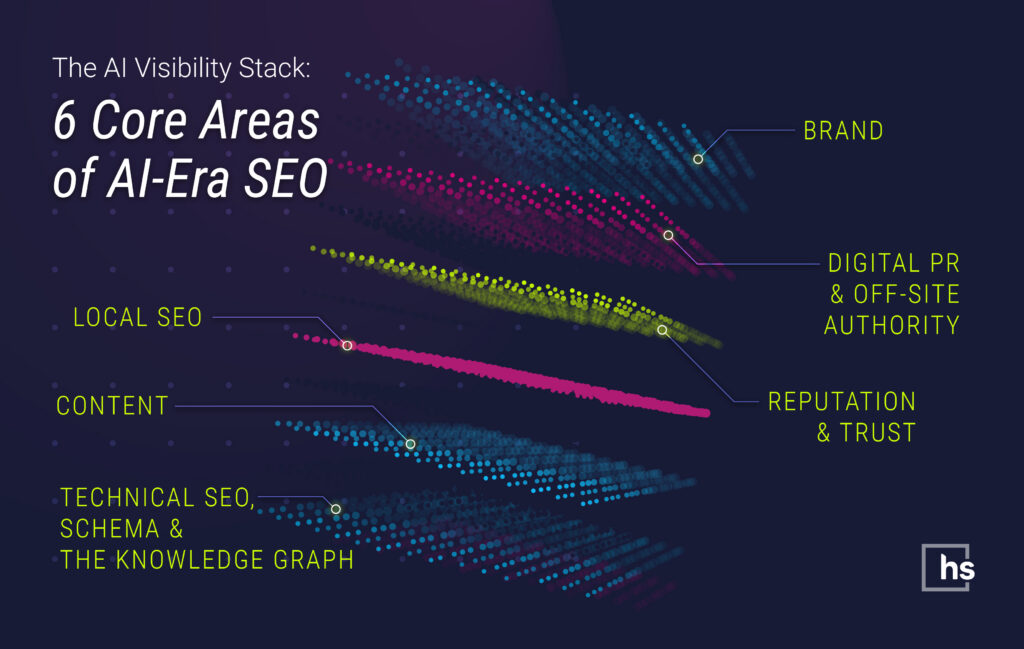
This article is the third playbook in a seven‑part series on How to Show Up in AI Overviews, ChatGPT, Claude, Gemini and Perplexity for healthcare brands. The overview introduces the AI Visibility Stack™—six core areas of AI‑era SEO—then links to six deep‑dive playbooks. Together, they’re designed so your marketing, digital and clinical leaders can work from the same framework rather than chase disconnected SEO tips. (You can start with the first playbook here: Brand in an AI‑First Search World: Why Known Healthcare Brands Win More AI Recommendations.)
1. Why Technical SEO Matters More in the AI Era
AI answer engines still rely on crawlers, indexes and ranking systems—but they use them differently than traditional search. AI agents often look for natural language—specific question-header formats (e.g., “What are the symptoms of [condition]?” to pull into a summary.
Instead of ranking a single page, AI systems typically:
- Pull from multiple pages and external sources
- Extract specific passages, facts or definitions
- Synthesize those inputs into a single answer
That process magnifies the cost of technical ambiguity.
When a healthcare site is slow, inconsistently structured or poorly linked, AI systems are more likely to:
- Miss important pages entirely
- Misinterpret relationships between entities (organizations, providers, locations, services)
- Default to better-structured competitors as citation sources
In other words, technical SEO now determines whether AI systems can confidently use your content at all.
This aligns with guidance from Gartner, which has noted that as generative AI reshapes discovery, organizations with clearer, lower-risk digital signals are more likely to be surfaced—particularly in regulated and high-trust categories like healthcare.
2. Clean Architecture and Intentional Internal Linking
Clean site architecture remains foundational—but in AI-driven search, it does more than support crawlability. It teaches machines what matters most.
Healthcare organizations benefit when services, conditions, providers and locations are grouped according to patient logic rather than internal org charts. Clear hierarchies and predictable URL structures reduce ambiguity and help AI systems identify authoritative pages.
Effective healthcare architecture typically includes:
- Logical information grouping, organized by specialty or patient need
- Service or condition hubs that act as definitive reference pages
- Contextual internal links connecting hubs to providers, locations, FAQs and related education
- Shallow depth, with high-value pages accessible within a few clicks
This structure signals priority, relevance and topical ownership—making it easier for AI systems to determine which pages should anchor an answer.
3. Performance, Mobile Experience and Technical Hygiene
Performance and usability are no longer just UX concerns—they’re eligibility filters.
Healthcare searches often begin on mobile devices, frequently under stress or urgency. Pages that load slowly, shift unpredictably or hide essential information increase friction for users and AI crawlers.
If the technical SEO is great but content is hidden behind heavy JavaScript or a “load more” button, the AI might see the page but fail to clip the relevant text for a citation.
Strong technical hygiene includes:
- Fast, stable performance, especially mobile Core Web Vitals (LCP, CLS, INP)
- Mobile-first layouts that surface services, providers, locations and contact details clearly
- Secure, clean infrastructure, including HTTPS, minimal JavaScript interference and controlled redirects
- Ongoing maintenance, addressing broken links, duplicate URLs and crawl traps
- Ensuring that the most important facts such as address, phone and services are present in the initial HTML delivery, not just rendered via client-side JavaScript
SEMrush research consistently shows that unresolved technical issues reduce crawl efficiency and limit how fully content is indexed and reused across modern search experiences.
4. Schema Markup: Your Translation Layer for AI
Schema markup is one of the most powerful tools for AI readiness because it removes guesswork.
Schema tells machines what your content means, not just what it says. In healthcare—where ambiguity introduces risk—this clarity is essential.
High-priority schema types for healthcare organizations include:
- MedicalOrganization / Hospital / MedicalClinic / MedicalBusiness
- Physician (credentials, specialties, affiliations, locations)
- HealthcareService / MedicalSpecialty
- MedicalCondition
- MedicalProcedure / MedicalTherapy
- FAQPage
Used together, these schemas create a machine-readable map that distinguishes conditions from treatments, providers from locations and educational content from transactional pages.
Two other "must haves" for AI are:
- About and Mentions properties: These are sub-properties within WebPage or Article schema that tell the AI, “This page is about [Entity: Diabetes] and mentions [Entity: Insulin].” This removes all ambiguity.
- ContactPoint: For healthcare, explicitly defining the “appointment” or “emergency” phone numbers in the MedicalOrganization schema is a high-value signal for AI agents trying to help a user take action.
AI engines look for social proof and authority signals in the code. Using the sameAs property in Physician and MedicalOrganization schema allows you to link a doctor’s profile to their LinkedIn, their Board Certification page, or their NPI profile. This closes the loop for the AI to verify they are a real, credentialed expert.
As Moz has emphasized, structured data doesn’t replace quality—but it dramatically improves how search engines and AI systems interpret and trust high-stakes content.
5. Building Explicit Relationships Between Entities
AI systems don’t evaluate entities in isolation—they evaluate networks of meaning.
Schema allows healthcare organizations to explicitly encode those relationships instead of leaving them to inference.
Common relationship mappings include:
- Providers linked to organizations via memberOf or affiliation
- Providers connected to specialties and services using medicalSpecialty and availableService
- Conditions tied to treatments through possibleTreatment, usedToDiagnose or procedureType
- Locations associated with parent entities using branchOf, supported by consistent NAP data
These connections form an internal knowledge graph that helps AI systems determine relevance across condition, provider and geography—especially in local and “near me” scenarios.
6. The Knowledge Graph and Knowledge Panels: Where Schema Becomes Visible
All the schema work described above serves one ultimate goal: convincing Google that your organization, your physicians, and your locations are real, trustworthy, well-defined entities—not just a collection of web pages.
Google maintains what's called the Knowledge Graph—a massive, structured directory of real-world entities and the relationships between them. Think of it as Google's internal source-of-truth: a master record of who you are, what you do, where you operate, and who your providers are. When Google is confident it understands your organization as a distinct entity, it can represent you there.
When that happens, you may earn a Knowledge Panel—the authoritative information box that appears on the right side of Google's search results when someone searches your brand or a physician's name. For healthcare organizations, this is no longer a nice-to-have. In an era where AI Overviews, zero-click results, and answer engines respond before a patient ever visits your website, the brands that get cited, featured, and trusted are the ones Google has already categorized as verified entities in its Knowledge Graph.
Three signals that move the needle:
- Entity pages with clean schema — Clear, structured organization, location, and physician pages on your website, marked up with the schema types covered in this guide
- A complete Google Business Profile — Accurate name, address, phone, hours, and categories for every location, kept current and consistent
- Consistent presence across authoritative directories — Your NPI registry listing, Healthgrades, WebMD, Doximity, and LinkedIn profiles should all reflect identical information; discrepancies create doubt in Google's entity model
Schema markup is what stitches these signals together and tells Google: these are all the same organization. It doesn't guarantee a Knowledge Panel—but without it, you're invisible to the systems making that determination. Organizations that combine solid on-site schema with consistent off-site signals typically begin seeing entity recognition improvements within four to twelve weeks.
Think of it this way: the technical SEO and schema work in this guide gets you into Google's directory. The Knowledge Panel is your verified listing in that directory—and increasingly, it's the first thing a prospective patient or referring physician sees when they search your name.
For a deeper, technical dive into Knowledge Graph Optimization and how to earn and maintain entity status in the AI era, see Brandon Schakola’s upcoming blog: How AI Evaluates Your Healthcare Website: Technical SEO, Schema & the Knowledge Graph — Publishing July 2026.
7. Scalable, AI-Friendly Templates for Locations and Providers
Multi-location healthcare organizations can’t hand-craft every page—but scale doesn’t require sacrificing clarity.
Effective templates balance consistency with local relevance. AI systems benefit when core fields appear in predictable locations, while still allowing room for context.
High-performing templates typically include:
- Standardized fields for NAP, hours, services, insurance and contact options
- Provider associations, clearly linking clinicians to locations and services
- Localized content areas, such as brief introductions or FAQs that reflect community needs
When schema is embedded at the template level, AI systems can crawl any instance and immediately understand both what’s unique—and how it fits into the larger organization.
How Healthcare Success Implements This
When we help healthcare organizations prepare their websites for AI-driven search, we don’t treat technical SEO and schema as backend hygiene. We treat them as visibility infrastructure—foundational systems that determine whether AI engines can understand, trust and reuse your content.
Our approach starts with strategy, not tools. We identify the conditions, procedures and service lines that matter most to an organization’s growth, reputation and patient access goals, then design the technical foundation to support those priorities.
In practice, that means:
- Entity-first planning
Before we touch schema, we map the real-world entities that matter: the organization, its locations, its providers and its core services and conditions. This ensures technical implementation reflects clinical reality, not just page templates. - Hub-based site architecture
We design and reinforce service and condition hubs that function as definitive reference points. Supporting pages—providers, locations, FAQs and educational content—are intentionally linked to those hubs so AI systems can identify topical ownership and authority. - Schema as a system, not a plugin
We implement schema holistically across organizations, locations, providers, services, conditions, procedures and FAQs. Rather than isolated markup, we focus on encoding relationships so AI systems can understand how everything connects. - Performance and crawlability as eligibility requirements
We audit and address Core Web Vitals, mobile usability, crawl depth, redirects, and indexation issues—especially on high-value pages—so AI systems can reliably access and interpret content without friction. - Scalable templates with built-in clarity
For multi-location and multi-provider organizations, we design templates that balance consistency and local relevance. Schema is embedded at the template level, allowing every instance to be immediately understandable to machines. - Ongoing governance and auditing
AI-readiness isn’t a one-time project. We build processes for regular technical and schema audits, especially after redesigns, migrations or service expansions, so visibility doesn’t quietly erode over time.
The goal isn’t to “optimize for AI” in a narrow sense. It’s to make healthcare websites structurally unambiguous—so when AI systems assemble answers about conditions, treatments, providers or locations, your organization is easy to understand, easy to trust and easy to cite.
This blog post is the third deep dive in a seven-part series. To keep building a unified AI Visibility Stack, we encourage you to continue reading the rest of the series:
- Brand in an AI‑First Search World
- Content That AI Loves to Cite
- Local SEO in the Age of AI
- Reputation & Trust in an AI World
- Off‑Site Digital PR in an AI World
Mini-FAQ: Technical SEO & Schema in an AI World
Which schema types should we prioritize first?
Start with core entities and relationships: MedicalOrganization (or Hospital/MedicalClinic), Physician, HealthcareService or MedicalSpecialty, MedicalCondition, MedicalProcedure and FAQPage. These give AI systems the minimum viable map needed to use you as a source.
Do we need custom development for schema?
Not always—but schema still requires expertise. Plugins can accelerate implementation, but incorrect or incomplete markup can create confusion. Complex multi-location organizations often benefit from custom or semi-custom approaches.
How often should we audit technical SEO and schema?
At least annually, plus after any major redesign or migration. Quarterly spot checks on crawlability, Core Web Vitals and schema coverage for priority pages help catch issues early.
Does schema guarantee AI citations?
No, but it materially improves your chances. Schema doesn’t override content quality or E-E-A-T; it removes friction. Without it, AI systems must infer meaning. With it, you’re communicating in their native language.
What's the difference between schema and the Knowledge Graph?
Schema is the structured code you add to your website—it tells Google's machines what your content means. The Knowledge Graph is Google's internal directory of real-world entities built from thousands of signals, including schema. Schema is the input; the Knowledge Graph is the result. And the Knowledge Panel—that information box patients see when they search your name—is the visible proof that you've made it into Google's directory as a recognized, trusted entity.
Subscribe for More:
Don’t miss future insights—subscribe to our blog and join us on LinkedIn: Stewart Gandolf and Healthcare Success.