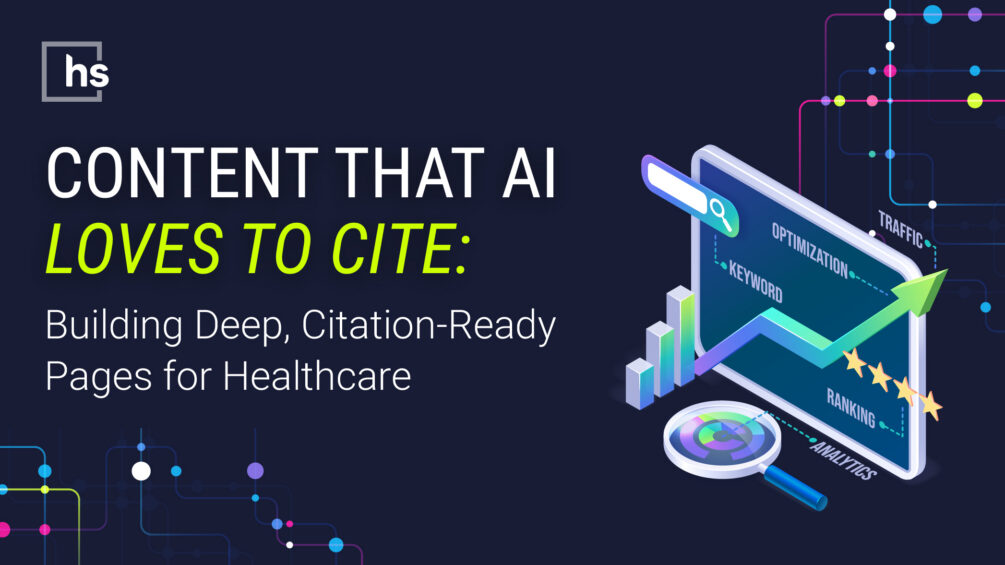
Content That AI Loves to Cite: Building Deep, Citation-Ready Pages for Healthcare
In today’s AI-powered search environment, healthcare content must go beyond basics and deliver as a trusted source.
It’s no longer enough to publish frequent, surface-level posts on every micro-topic. AI engines like Google AI Overviews, ChatGPT, Claude, Gemini and Perplexity already know the basics—they’re trained on millions of pages. What they need is clear, deep, trustworthy content they can quote.
That changes the strategic question from “How do we create more?” to “Where do we need to be definitive?”
For hospitals, health systems and multi-location groups, I believe the winners will be organizations that build fewer high-quality, citation-ready pages around their most important conditions and service lines. These pages aren’t written to chase keywords; they’re designed to function as primary sources that AI systems can confidently rely on.
This aligns with industry analysts' observations: As generative search matures, authority and completeness outweigh volume—especially in high-risk fields like healthcare. Gartner notes that generative AI increasingly favors sources that reduce ambiguity and risk, elevating trusted, expert-backed content over shallow coverage.
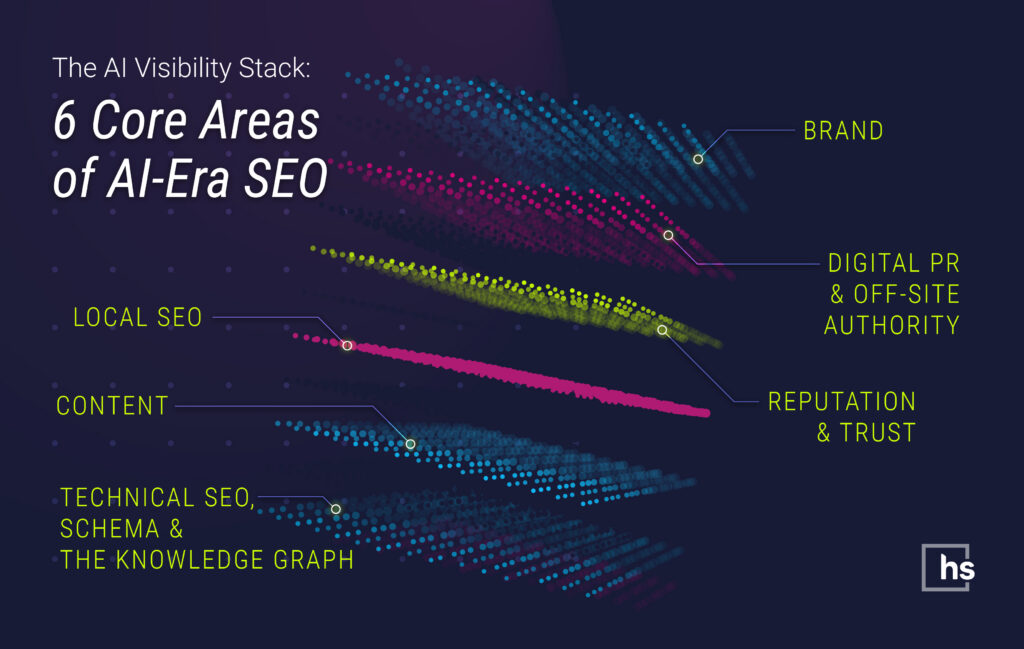
This article is the second playbook in a seven‑part series on How to Show Up in AI Overviews, ChatGPT, Claude, Gemini and Perplexity for healthcare brands. The overview introduces the AI Visibility Stack™ —six core areas of AI‑era SEO—then links to six deep‑dive playbooks. Together, they’re designed so your marketing, digital and clinical leaders can work from the same framework rather than chase disconnected SEO tips. (You can start with the first playbook here: Brand in an AI‑First Search World: Why Known Healthcare Brands Win More AI Recommendations.)
1. What makes content “citation-ready” for AI?
When AI systems assemble an answer, they look for passages that are:
- Directly relevant to the question and its natural follow-ups
- Clear and self-contained enough to stand alone in a paragraph
- Supported by visible expertise and trustworthy context
In healthcare, that usually means:
- Answer-first paragraphs that address a question clearly in roughly 40 to 200 words
- Logical structure, with headings that reflect real patient concerns (symptoms, diagnosis, treatment options, risks, recovery, next steps)
- Strong E-E-A-T signals on the page, including authorship, clinical review, references and appropriate disclaimers
When content checks these boxes, you make it easier for AI systems to treat your page as a safe primary source rather than skimming it as generic background material.
2. Fewer, deeper hubs instead of scattered posts
What I’m seeing consistently is that long, specific healthcare queries—often seven or more words—are far more likely to trigger AI summaries.
Questions like:
- “How long is recovery after ACL reconstruction?”
- “Side effects of radiation therapy for breast cancer”
These aren’t questions thin pages can answer responsibly.
An AI-era content model looks like this:
- Build focused hubs for each important condition or service line (e.g., knee replacement, cardiac catheterization, inpatient behavioral health, bariatric surgery), covering the full patient journey from symptoms to recovery, as well as FAQs.
- Each hub covers the full patient journey: symptoms, diagnosis, treatment options, risks, recovery, lifestyle considerations, FAQs and when to seek urgent care.
- Supporting content (blogs, videos, case studies) links back to the hub instead of competing with it.
Instead of publishing 10 short posts about knee surgery, you create one definitive Knee Replacement Guide—a page that both patients and AI systems recognize as authoritative.
3. Structuring pages around real patient questions
Generative search rewards content that resembles how people actually think and speak. That means moving away from keyword lists and toward question-driven architecture.
In practice, this looks like:
- H2 and H3 headings that reflect common patient questions
(“Do I need knee replacement surgery?” “What happens during the procedure?” “How long is recovery?”) - A dedicated FAQ section that captures precise concerns
(“When can I drive?” “Can I climb stairs?” “What are the risks?”) - Answers that stand on their own
Start with the direct response, then add nuance and clinical context.
This structure enables AI engines to quickly find, understand and reuse your answers—whether the query comes through typed search, voice assistants or conversational interfaces.
4. Making your content visibly expert and trustworthy
Healthcare is a “Your Money or Your Life” (YMYL) category. Both Google and AI platforms hold it to a much higher standard. Strong E-E-A-T (Experience, Expertise, Authoritativeness, Trustworthiness) isn’t optional—it’s foundational.
On high-value content pages, that means:
- Clear authorship, including credentials and links to detailed bios
- Clinical review for vital topics, with a real physician review and visible date
- External alignment, citing reputable guidelines and avoiding conflicting recommendations
- Plain-language disclaimers clarifying that content is informational, not medical advice
Search quality research reinforces this. Moz has repeatedly emphasized that visible expertise, review processes and accountability are critical trust signals in YMYL categories like healthcare.
These signals don’t just reassure patients—they help AI systems determine whether your content is safe to quote.
5. Leveraging FAQs, video and other formats
AI is multimodal. It doesn’t rely solely on long-form text—it also pulls from FAQs, video and clearly structured sections.
High-leverage formats include:
- Structured FAQs, supported by FAQPage schema
- Short clinician videos, typically two to five minutes, embedded on key pages
- Checklists and step-by-step sections like “How to prepare” or “What to expect after your visit”
You don’t need every format on every page. But for your most important conditions and procedures, combining text, FAQs and video gives AI multiple trusted ways to engage with your content.
6. Where AI-assisted drafting fits (and where it doesn’t)
AI can be an effective drafting assistant, but it should never replace clinical judgment.
In healthcare, use AI to scale structure and drafts, but always add expert review.
A practical workflow looks like this:
- Strategy defines the topic, outline and key messages.
- AI generates a structured draft and FAQs under strict guardrails.
- Clinicians and medical editors review for accuracy and nuance; SEO specialists refine structure and internal linking.
This hybrid model allows teams to scale high-quality, physician-backed content without inundating clinical staff—and keeps content aligned with E-E-A-T expectations.
How We Implement This at Healthcare Success
When we help healthcare organizations build content for AI-driven search, we don’t start with keywords or publishing quotas—we start with strategic importance and clinical reality.
Our process normally includes:
- Identifying the conditions, procedures and service lines that matter most to the organization’s growth and reputation
- Designing deep, patient-journey-based content hubs instead of fragmented blog posts
- Structuring pages around real patient questions, with answer-first sections AI can safely reuse
- Layering in visible authorship, clinical review and external alignment to support E-E-A-T
- Consolidating and upgrading existing content before creating net-new pages whenever possible
The goal isn’t to “game” AI systems. It’s to publish content that’s genuinely useful, clinically sound and clearly accountable—so that when AI platforms summarize healthcare answers, your organization is the source they trust.
This blog post is the second deep dive in a seven-part series. To keep building a unified AI Visibility Stack, we encourage you to continue reading the rest of the series:
- Brand in an AI‑First Search World
- Technical SEO & Schema for AI
- Local SEO in the Age of AI
- Reputation & Trust in an AI World
- Off‑Site Digital PR in an AI World
Mini-FAQ: Building Content AI Loves to Cite
Q: How is “citation-ready” content different from traditional SEO content?
Traditional SEO content was often written to rank for a keyword and earn a click. Citation-ready content is written to stand on its own inside an AI-generated answer. That means it must be accurate, complete, clearly structured and supported by visible expertise. AI systems don’t need teasers or cliffhangers — they need safe, self-contained explanations they can quote without introducing risk.
Q: Do we still need blog posts, or should everything be a long guide?
Blog posts still have a role, but their purpose has shifted. In an AI-first world, blogs work best as supporting content that reinforces and links back to deep condition or service-line hubs. The hubs are what AI systems treat as primary sources; blogs provide context, updates, perspectives and examples that strengthen authority without fragmenting it.
Q: How long should a citation-ready healthcare page be?
There’s no ideal word count, but most citation-ready pages are long enough to fully answer the patient or decision-maker’s questions without forcing them to search elsewhere. For major conditions or services, that often means 1,500 to 3,000 words—structured into well-defined sections—rather than a single block of text. Depth matters more than length for its own sake.
Q: What’s the biggest mistake healthcare organizations make with AI-era content?
Publishing more instead of publishing better. Within AI-driven search, thin or redundant content doesn’t just underperform—it can dilute authority. Organizations that consolidate, upgrade and deepen their most important pages tend to earn far more AI visibility than those that keep adding surface-level posts.
Subscribe for More:
Don’t miss future insights—subscribe to our blog and join us on LinkedIn: Stewart Gandolf and Healthcare Success.