
Local SEO in the Age of AI: Winning “Best [Specialty] Near Me” for Healthcare Where AI Meets Real-World Care
Where AI Meets Real-World Care
Despite changes in healthcare marketing, care decisions remain local.
When patients use Google AI Overviews, ChatGPT or similar tools for queries like “best cardiologist near me” or “urgent care open now in [city],” these systems must recommend real providers, often in urgent moments.
To do that, AI systems blend:
- Local signals (locations, proximity, availability)
- Reputation signals (reviews, ratings, sentiment)
- Trust signals (brand consistency, content clarity, corroboration across sources)
For hospitals, health systems and multi-location practices, this means local SEO is no longer just about map pack visibility. It has become a decision layer—one of the primary ways AI determines whom to recommend when a patient is about to choose a care provider.
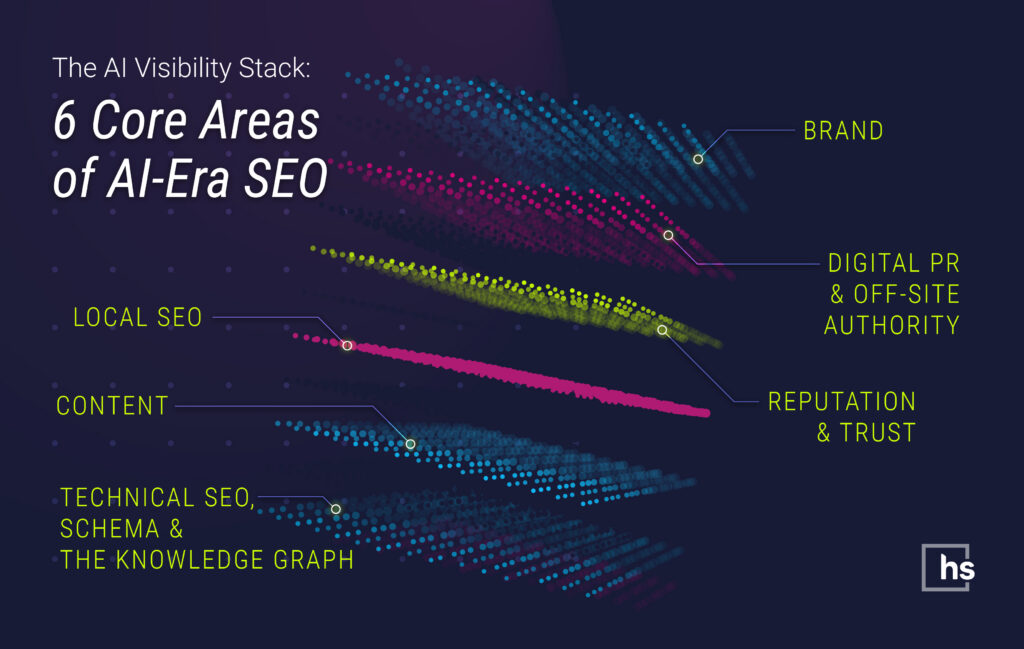
This article is the fourth deep dive in a seven‑part series on How to Show Up in AI Overviews, ChatGPT, Claude, Gemini and Perplexity for healthcare brands. Our overview introduces the AI Visibility Stack™—six core areas of AI‑era SEO—then links to six deep‑dive playbooks. Together, they’re designed so your marketing, digital and clinical leaders can work from the same framework instead of chasing disconnected SEO tips.
1. How AI Interprets “Near Me” Healthcare Searches
In AI-mediated search, “near me” is no longer a simple distance calculation. It’s an interpretation of intent.
When an AI system receives a local healthcare query, it ordinarily follows a multi-step process:
- Interprets the user’s intent (find care now vs. learn generally)
- Retrieves relevant local entities from listings, structured data and trusted sources
- Evaluates those entities based on proximity, relevance, reputation and confidence
- Presents a short list—often with language determined by reviews and profile data
AI evaluates your full local footprint—not just your website. Google Business Profiles, location pages, listings and reviews either reinforce or contradict each other.
AI-powered systems more often favor entities with clear, corroborated signals across multiple sources, especially in high-risk categories like healthcare.
If your signals are inconsistent, AI hesitation creeps in—and hesitation often results in invisibility.
2. Getting the Local SEO Foundations Right (Still Matters—More Than Ever)
Local SEO fundamentals still matter, but now they validate AI’s choices.
At a minimum, strong AI-ready local foundations include:
- Google Business Profiles (GBP) for every location
Accurate name, address, phone, hours, categories, attributes (e.g., accessibility, telehealth), photos and succinct descriptions. - Robust location pages on your website
One page per location with services offered, providers, access details (parking, directions), insurance information and clear calls to action—not just a map and phone number. - Consistent NAP and categories throughout listings
Your name, address, phone number and primary categories must match across GBP, major directories, payer finders and association listings.
These signals help AI confidently connect a query like “urgent care near [neighborhood]” to a specific, trustworthy entity—and confirm that the information is up to date.
3. Schema, Structured Data and Local Entity Clarity
Schema acts as the connective tissue between your website and your local presence. A schema is code added to your website that helps search engines better understand your business information.
For AI systems, schema doesn’t just strengthen understanding—it reduces risk. It explicitly defines who you are, where you operate and what services you provide.
For local healthcare SEO, priority schema typically includes:
- LocalBusiness / MedicalOrganization / Hospital / MedicalClinic on location pages
- Physician schema on provider profiles, linked to locations and specialties
- Consistent NAP, categories and services reflected across schema and GBP
When schema, listings, and on-site content reinforce one another, AI systems can confidently answer questions like “hip specialist near me” with named providers at specific locations—instead of defaulting to generic or less risky alternatives.
Moz emphasizes that structured data is especially important in YMYL categories, where explicitness and corroboration directly influence trust and visibility.
4. Local Content That Resembles How Patients Actually Speak
Local SEO in the AI era isn’t just about having a profile and a page—it’s about contextual relevance.
AI systems reward content that replicates how patients describe their needs, especially in voice-driven queries.
High-impact local content strategies include:
- Short, location-aware guides
(“Where can I get same-day orthopedic care in [city]?” or “Pediatric urgent care options in [region]”) - Natural references to neighborhoods or regions
Mention service areas naturally, without forced geo-stuffing. - Seasonal and community-specific topics
Allergy season, flu clinics, heat-related illness or local health programs tied to specific locations.
This kind of content helps AI map your locations to real, conversational queries—not just templated “city + specialty” pages.
5. Reviews and Reputation as AI Tie-Breakers
When proximity and services are similar, reputation often decides the winner.
AI-driven local recommendations typically evaluate:
- Review volume sufficient to establish credibility
- Recency, signaling that patient experience is current
- Rating and sentiment, including what patients actually mention (staff, access, bedside manner, wait times)
In healthcare, reviews are more than social proof—they signal confidence. A compliant, well-managed review program on GBP and healthcare-specific platforms gives AI stronger justification to label a provider "top rated" or "best."
Review signals increasingly influence local visibility when combined with proximity and category relevance—particularly in competitive markets.
6. Scaling Local SEO Across Many Locations
For enterprise systems and PE-backed groups, the challenge is governance, not just optimization.
Strong multi-location programs share a few defining traits:
- Standardized GBP and location page templates, with central oversight and local inputs
- A single source of truth for location and provider data synced across platforms
- Centralized review policies and response playbooks, with local training
- Market-level monitoring, not just ZIP-code snapshots
This discipline makes local SEO a durable signal framework that AI systems can rely on.
How Healthcare Success Implements AI-Ready Local SEO
When we help healthcare organizations win “best [specialty] near me” visibility, we make local SEO a trust system AI relies on for real recommendations—not just a listings exercise.
Our approach focuses on eliminating ambiguity across the entire local ecosystem, so AI systems can confidently connect who you are, where you operate and what care you provide.
In practice, that means:
- Entity-first local mapping
We inventory actual entities—organizations, locations, providers and services—so local optimization reflects clinical reality rather than legacy data or incomplete listings. - GBP governance at scale
We standardize Google Business Profile templates, category strategies and attribute use across locations, administering updates centrally to keep proximity, availability and service signals consistent as organizations change. - Location pages built for AI interpretation
We design location pages that go beyond maps and phone numbers—clearly tying services, providers, access details and FAQs to each site. The schema is embedded so that AI systems can treat each location as a distinct, trustworthy entity. - Schema and local data matching
Schema markup, GBP data and listings all reinforce the same facts—name, address, specialties, providers and services—so AI sees a single, coherent story. - Review programs designed for credibility, not volume alone
We help organizations implement compliant review-generation and response workflows that value recency, detail and patient-experience signals that AI systems actually use to differentiate “best” options. - Market-level visibility monitoring
We track AI-era indicators—presence in AI Overviews, local citations and comparative visibility for “best [specialty] near me” across markets, not just ZIP-code rankings. - Ongoing governance and drift prevention
Local SEO can erode quietly over time. We run recurring audits of listings, pages, schema and reviews—especially after acquisitions, rebrands or expansions—so AI trust remains strong.
The objective isn’t to chase every local ranking fluctuation. It’s to build a durable, AI-readable local footprint that consistently bolsters trust—so when patients ask AI systems where to go for care, your organization is an easy, confident choice.
Mini-FAQ: Local SEO in an AI-First World
Q: What’s the first local SEO fix to focus on for AI search?
Start with Google Business Profiles. Clean up names, addresses, phones, hours, categories, photos and links—then align those details with your location pages and key listings so AI systems see a consistent picture.
Q: Do we need a separate page for every location?
Yes, if you want to compete within AI-driven “near me” results. A single generic locations page is rarely enough. Each significant site needs its own page, ideally backed by schema.
Q: How much do reviews really matter?
A lot. AI systems weigh review volume, recency and sentiment heavily when labeling providers “best” or “top rated,” especially when proximity is similar.
Q: How do we measure local visibility in the AI era?
Go beyond rankings. Track AI Overview presence, citation frequency and local share of voice for priority specialties. Periodically test “best [specialty] near me” queries from different locations and log which entities appear.
The Bottom Line
“Near me” in healthcare now reflects intent and trust, not just mileage.
AI systems progressively favor organizations that present clear, consistent and corroborated local signals—across listings, content, reviews and off-site authority. When those signals align, you don’t just stay visible. You become the default recommendation.
This blog post is the fifth deep-dive in a seven-part series. To keep building a unified AI Visibility Stack, we encourage you to continue reading the rest of the series:
- Brand in an AI-First Search World
- Content That AI Loves to Cite
- Technical SEO & Schema for AI
- Reputation & Trust in an AI World
- Off‑Site Digital PR in an AI World
Subscribe for More:
Don’t miss future insights—subscribe to our blog and join us on LinkedIn: Stewart Gandolf and Healthcare Success.