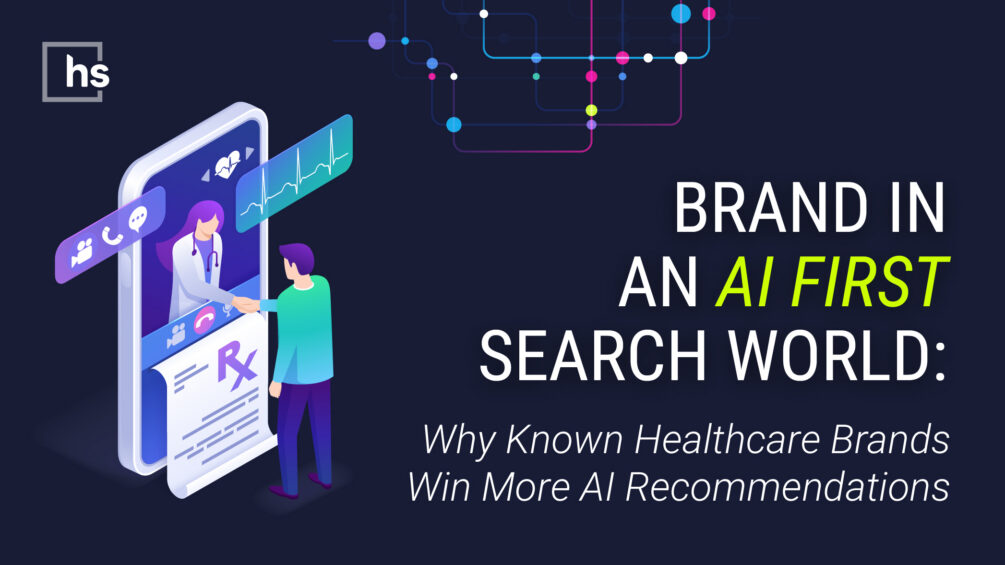
Brand in an AI‑First Search World: Why Known Healthcare Brands Win More AI Recommendations
In an AI‑first search world, your brand is now more than a logo and a tagline—it is a data asset that algorithms use as a shortcut for safety, relevance, and trust. When Google AI Overviews, ChatGPT, Claude, Gemini and Perplexity have to decide which hospital, health system or medical group to name, they lean toward brands they recognize, understand and see repeatedly in credible contexts.
For healthcare leaders, that means brand is now a ranking-and-routing heuristic. The stronger and clearer your brand, the more often AI systems default to you when patients ask, “Who should I trust for this?”—even before anyone lands on your website.
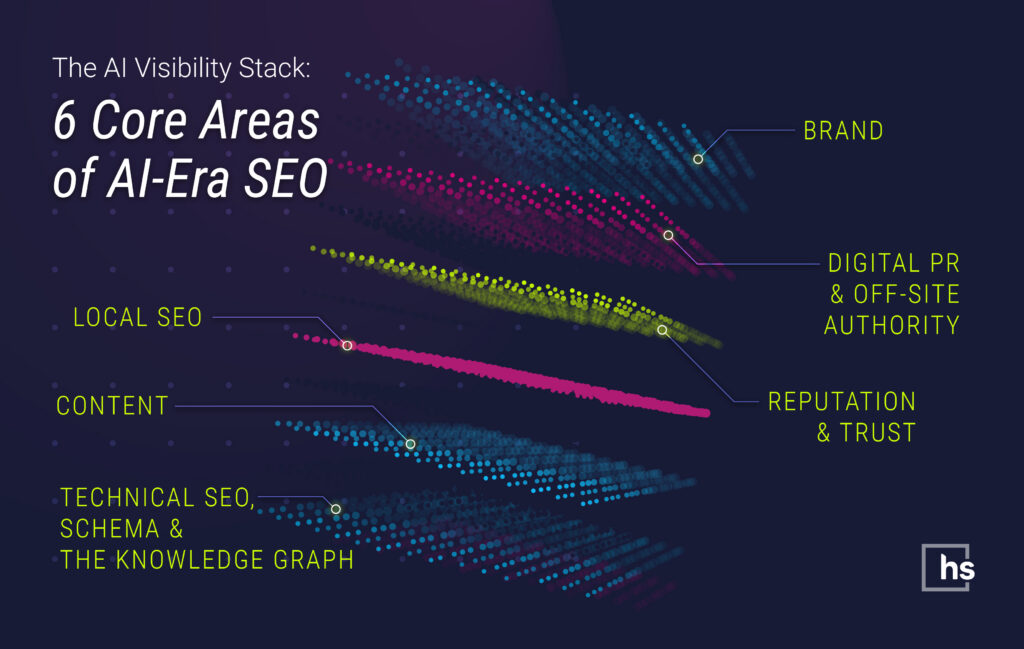
This article is the first playbook in our series on How to Show Up in AI Overviews, ChatGPT, Claude, Gemini and Perplexity for healthcare brands. The overview article introduces the AI Visibility Stack™—six core areas of AI‑era SEO—and links to a series of six focused playbooks. The series ensures your marketing, digital and clinical leaders use a unified framework rather than piecemeal SEO tips.
1. How AI uses brand as a shortcut
AI systems are designed to reduce risk and ambiguity, especially in healthcare. They don’t just match keywords; they try to answer questions like: “Which organizations do people actually turn to for this?” and “Which names appear repeatedly in trustworthy sources?”
Brand influences AI in three big ways:
- Recognition. Are you a known entity in the data the model was trained and tuned on—such as websites, profiles, news, reviews and medical content?
- Clarity. Is it obvious what you do, who you serve and where you operate, or is your positioning generic and diffuse?
- Reinforcement. Do external signals—PR, reviews, partnerships, citations—keep confirming that you are important and trustworthy in your niche?
If the answer is “yes” on all three, you’re far more likely to be named or cited in AI answers, particularly when queries are ambiguous (“best cancer hospital,” “top heart program near me”) and the model needs a safe default.
2. Clarity of positioning: giving AI a one‑sentence story
AI works best when it can compress you into a simple, accurate mental model: “regional children’s hospital,” “multi‑location orthopedic group focused on sports injuries,” “national behavioral health network” and so on.
Brand work in the AI era starts with:
- Specific positioning. Move beyond “comprehensive care for the whole family” to a clear statement of strengths, markets and differentiators.
- Consistency across properties. Your website, Google Business Profiles (GBP), LinkedIn, directory listings and press all need to tell the same story about who you are and what you’re known for.
- Service‑line level clarity. For key lines like cardiology, oncology, orthopedics, behavioral health or women’s health, make it explicit that you are an outstanding choice, not an also-ran.
This kind of clarity helps both people and models understand when you are the right answer to surface.
3. Branded demand and entity strength
Strong brands generate branded demand: searches and mentions that include your name plus a condition, service or geography (for example, “ABC Health cardiology,” “XYZ Ortho knee replacement,” “pediatric urgent care [brand]”).
AI systems treat those signals as proof that:
- Patients know who you are and associate you with specific needs.
- You are an active player in that category or region, not a marginal option.
You can strengthen this entity‑level brand signal by:
- Building robust “About,” leadership and culture pages that tell your story.
- Publishing consistent, excellent content under your brand (not microsites you can’t control long‑term).
- Making sure your name, abbreviations and acronyms are used consistently and not confused with similarly named organizations.
Over time, this helps AI models see you as a distinct, well‑defined entity in the healthcare industry.
4. Brand, content and E‑E‑A‑T
AI systems don’t just look at your name; they look at what your brand says and how it behaves. In healthcare, that’s largely about E‑E‑A‑T: Experience, Expertise, Authoritativeness, and Trustworthiness.
Brand and E‑E‑A‑T intersect when:
- Your experts are visible. Physicians and specialists are clearly associated with your brand, with detailed bios, affiliations and authored or reviewed content.
- Your content carries your signature. Service‑line hubs, condition guides and FAQs are explicitly tied to your organization and your clinicians—not anonymous, generic articles.
- Your tone fits your promise. If your brand promises compassionate, accessible care, your digital content should sound like a clear, empathetic clinician—not a dense journal article or generic marketing copy.
This is where your brand platform (positioning, messaging, tone) and your SEO/content strategy need to be aligned, not running as separate projects.
5. Off‑site brand signals: PR, partnerships and citations
Off‑site brand signals—PR, partnerships and citations—are how AI models see that the rest of the world takes you seriously.
Important signals include:
- Coverage in credible media. Trade publications, local press, academic partners and association websites that mention your brand in a positive, authoritative context.
- Partnerships and affiliations. Recognizable partners (universities, major health systems, respected vendors) that appear next to your name in news and web content.
- Data and thought leadership. Original research, reports or case studies that others quote and link to when discussing your specialty.
These signals support your digital PR pillar, but they also compound your brand pillar: Together, they teach AI models that you are not just another provider—you are a reference point in your category.
6. Practical steps for strengthening your brand in AI search
If you’re leading a hospital, health system or multi‑location practice, you don’t have to boil the ocean. Focus on a short list of brand‑centric moves that directly support AI visibility:
- Tighten your positioning. Update your brand narrative to clearly state who you serve, what you’re best known for and which markets you serve.
- Clean up naming and profiles. Ensure consistent names, abbreviations and descriptions across your site, GBP, directories, LinkedIn and key third‑party profiles.
- Showcase your experts. Expand and modernize physician and leadership bios; clearly connect them to service‑line content, media and speaking.
- Invest in a few high‑impact brand stories. Publish case studies, innovation stories or community impact pieces that your PR team can pitch and your content team can reuse.
- Monitor how AI describes you. Periodically run brand queries through AI tools and log how they talk about your organization; feed misalignments back into your brand, content and PR roadmap.
These steps tie your classic brand work directly to the signals AI uses to decide whether to put your name in front of patients.
This blog post is the first playbook in a seven-part series on building a unified AI Visibility Stack. Continue reading for insights on:
- Content That AI Loves to Cite
- Technical SEO & Schema for AI
- Local SEO in the Age of AI
- Reputation & Trust in an AI World
- Off‑Site Digital PR in an AI World
Mini‑FAQ: Brand in an AI‑First World
Q: How is brand different from reputation in AI search?
Brand is your overall identity and positioning—who you are, what you stand for and what you’re known for—while reputation is how patients and partners rate their actual experience with you. AI systems use both: brand as a shortcut for relevance and prominence, and reputation (reviews, ratings, sentiment) as proof that you’re a safe choice for “best [specialty] near me” and similar queries.
Q: Can a newer brand still win AI visibility against big systems?
Yes—if you are very clear and consistent about your niches and markets. AI doesn’t always default to the biggest brand; it prefers well‑defined, trusted entities that match the query’s intent and geography. A specialized orthopedic group or behavioral health network with strong content, local presence, reviews and PR in its lane can still be the “obvious” answer in its region.
Q: How often should we revisit our brand story for AI search?
You don’t need to rebrand every year, but you should review how your brand is described online at least annually, and any time you make major strategic or structural changes (new regions, mergers, new flagship services). As AI search evolves, keeping your brand story consistent, current and visible across your ecosystem is more important than frequent cosmetic refreshes.
Q: How do AI‑SEO tools fit into brand work?
AI‑powered SEO tools can help you see where your brand shows up in AI answers, how often you’re mentioned vs. competitors and which topics you’re already associated with. Use them to inform brand and content decisions—not to auto‑generate brand messaging—and keep humans in charge of anything that changes how you describe who you are.
Subscribe for More:
Don’t miss future insights—subscribe to our blog and join us on LinkedIn: Stewart Gandolf and Healthcare Success.