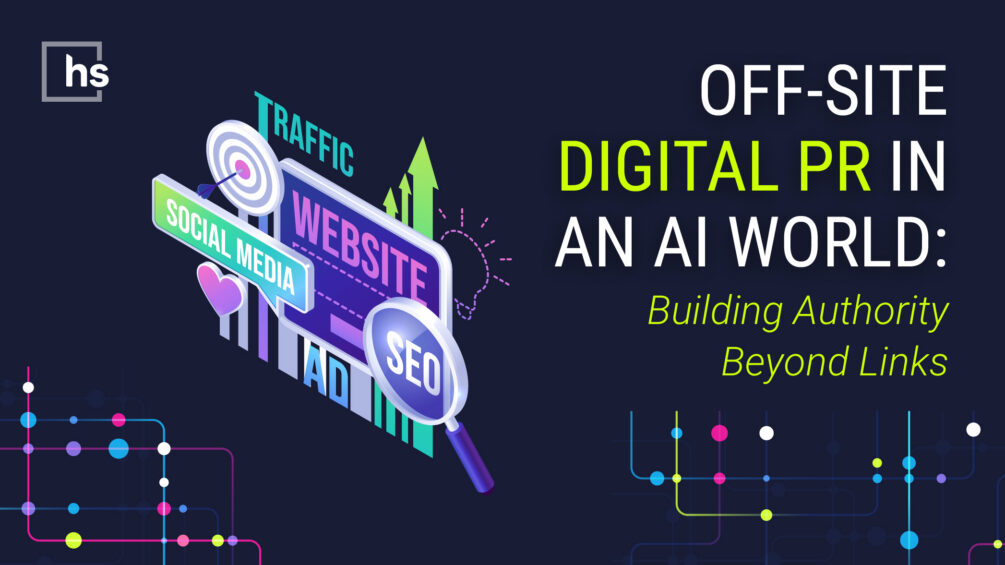
Off-Site Digital PR in an AI World: Building Authority Beyond Links
When AI Looks Beyond Your Website
When AI systems answer healthcare questions, they don’t limit themselves to your website.
They scan the wider web to understand who shows up repeatedly, in what contexts and with what level of credibility. They look at who mentions you, who links to you, who quotes your experts and whether reputable third parties treat your organization as authoritative.
For years, off-site SEO was narrowly defined as link building. In 2026, links still matter, but AI-driven search has expanded the definition of authority. AI systems now evaluate your entire off-site footprint: editorial links, unlinked mentions, press coverage, partnerships, expert citations and social proof that your brand matters in its domain.
For healthcare organizations, this shift elevates digital PR from a supporting tactic to a core authority engine. The goal is no longer to acquire links for rankings alone—it’s to earn coverage and citations that teach AI systems, “This organization is credible, visible, and safe to recommend.”
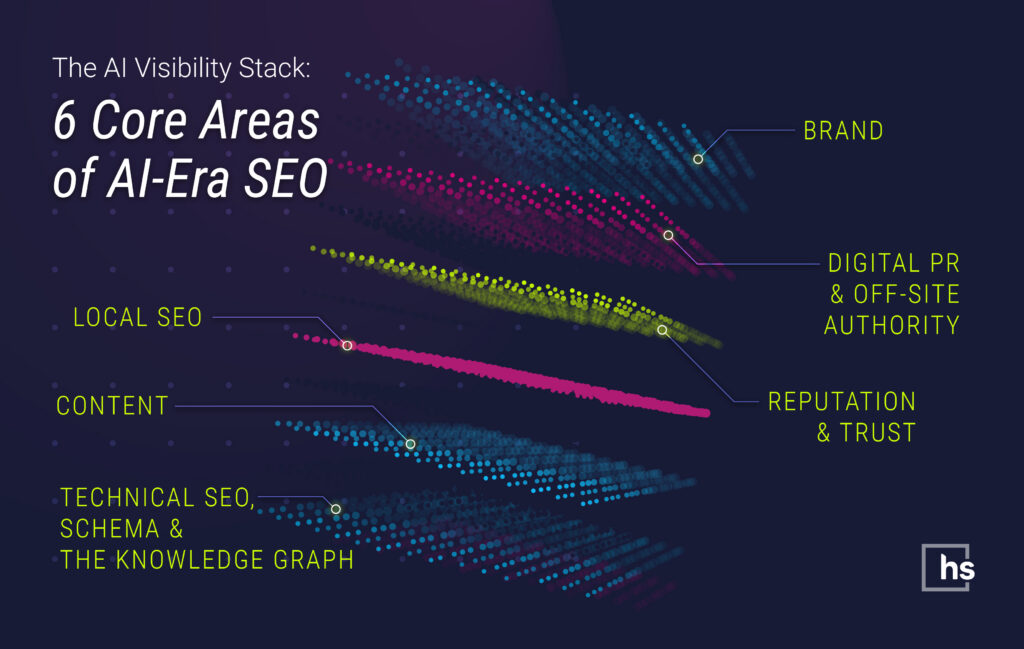
This article is the final exploration in a seven‑part series on How to Show Up in AI Overviews, ChatGPT, Claude, Gemini and Perplexity for healthcare brands. The overview introduces the AI Visibility Stack™—six core areas of AI‑era SEO—then links to six deep‑dive playbooks. Together, they’re designed so your marketing, digital and clinical leaders can work from the same framework rather than chase disconnected SEO tips.
1. How Off-Site Signals Influence AI Visibility
AI-driven search experiences—Google AI Overviews, ChatGPT, Perplexity, Claude—pull from many sources and look for patterns, not isolated wins.
They ask questions like:
- Which brands appear repeatedly in trusted environments?
- Are those brands referenced by credible publishers, institutions or experts?
- Do third-party descriptions of the brand correspond to how the brand describes itself?
Off-site signals that matter most include:
- Editorial backlinks from authoritative domains such as healthcare associations, journals, trade publications and major health publishers
- Unlinked brand mentions, where your organization appears in articles, reports or transcripts without a direct link
- Quotes and citations, where your clinicians, executives or data are referenced as sources
- Content and social reach, where widely shared content reinforces topic authority
Taken together, these signals help AI systems distinguish between providers that exist and brands the ecosystem treats as leaders.
This is consistent with Gartner's research, which has emphasized that generative AI systems prioritize sources that reduce uncertainty—especially in regulated, high-risk categories like healthcare. Authority is inferred not just from what you publish, but from how consistently others validate you.
2. Links, Mentions and the New Authority Mix
Links remain one of the strongest measurable off-site signals—but they are no longer the only signal AI systems count on.
In AI-mediated discovery, brand mentions—linked or unlinked—now function as “soft authority signals.” They indicate awareness, relevance and credibility even when no hyperlink is present.
In practice:
- Authoritative backlinks from relevant, authoritative sites still support traditional rankings and AI discovery.
- Unlinked mentions signal that people talk about your brand organically, which AI systems use to assess prominence.
- Link reclamation—turning unlinked mentions into links—is a low-friction way to strengthen authority.
Digital PR programs that intentionally generate both mentions and links create a richer, more resilient authority profile than old-school link building alone.
Moz research has long shown that brand mentions correspond closely with perceived authority and visibility, especially as search systems move beyond purely link-based evaluation.
3. Digital PR Plays That Work for Healthcare
Healthcare organizations have assets that many industries don’t: clinical expertise, data, innovation stories and community impact. Digital PR translates those assets into off-site authority.
High-leverage plays include:
- Thought leadership in vertical and mainstream media
Bylined articles, expert commentary and op-eds in healthcare business outlets, clinical trade media and regional press position leaders as trusted voices. - Data-driven reports and surveys
Original research on patient behavior, outcomes, access or trends that journalists and analysts cite - Conference appearances and webinars
Speaking roles and panel participation that often generate coverage, backlinks and citations - Partnership and innovation announcements
Meaningful collaborations with health systems, universities or technology providers that strengthen credibility.
These activities create content others want to reference—which is exactly what AI engines look for when assembling answers and examples.
4. Aligning Digital PR With AI-Era Search Strategy
Not every PR hit moves the needle for AI visibility.
To boost impact, digital PR must correspond to the same topics and entities your on-site SEO and schema prioritize.
Effective alignment includes:
- Defining priority topics (conditions, service lines, populations) and priority entities (flagship hospitals, key physicians, branded programs)
- Using SEO and AI data to identify high-interest questions and subtopics
- Targeting PR at intersections where your expertise coincides with demand (e.g., access to behavioral health, outpatient innovation, AI in diagnostics)
- Ensuring external coverage reinforces the same positioning and terminology used on your site.
When PR, content, schema and technical foundations tell the same story, AI confidence increases.
5. Measuring Digital PR Impact in an AI World
To justify investment, digital PR must be measured as an authority driver—not a vanity channel.
Useful metrics include:
- Authority of referring domains, especially healthcare-relevant sites
- Brand mentions over time, both linked and unlinked
- AI visibility and share of voice, including citations and mentions in AI Overviews and LLM responses
- Assisted impact, such as branded search lift or direct traffic following major coverage
According to SEMrush analysis, brands that appear consistently across authoritative third-party sources are more likely to be referenced in AI-generated answers—often independent of raw backlink counts.
6. Where AI-Powered Tools Fit—and Where They Don’t
AI tools can make digital PR more efficient—but they should augment strategy, not replace it.
High-value uses include:
- Discovering unlinked mentions and outreach opportunities at scale
- Monitoring how AI platforms reference your brand and competitors
- Summarizing large volumes of coverage and sentiment for leadership
Be cautious with:
- Fully automated PR or outreach platforms
- AI-generated guest posts or spammy link schemes
- Tools that modify live content or structured data without human review
In healthcare, poorly governed automation can introduce compliance, reputational and SEO risks that are difficult to undo.
Mini-FAQ: Digital PR, AI Authority and What’s Next
Q: Is digital PR really different from classic link building?
Yes. Digital PR focuses on earning coverage and citations from authoritative sources that sincerely want your expertise. The resulting links plus mentions are harder to fake, more credible to AI systems and more influential for visibility.
Q: Do unlinked mentions really help AI search?
Evidence suggests they do. Brand mentions correlate closely with AI visibility because they signal awareness and authority—even when no link is present.
Q: How do we keep ahead without chasing every AI update?
Focus on durable pillars: brand clarity, deep content, clean technical foundations, strong local presence, solid reputation and credible off-site authority. Review them regularly instead of reacting weekly.
Closing the Series: From Tactics to Durable AI Visibility
This article closes the six-part deep dive into the AI visibility stack—but the work it describes is ongoing.
The healthcare brands that win AI-driven search aren’t chasing a single trick. They coordinate brand, content, technical SEO, local presence, reputation and digital PR into a system that improves over time.
If your organization does that—and measures it—you won’t have to guess how AI will treat you.
You’ll have earned the right to be the answer when patients and referrers ask for help.
For a full picture of SEO in the age of AI, read the other playbooks in this series:
- How to Show Up in AI Overviews, ChatGPT and Perplexity
- Brand in an AI-First Search World
- Content That AI Loves to Cite
- Technical SEO & Schema
- Local SEO in the Age of AI
- Reputation and Trust in an AI-First World
Subscribe for More:
Don’t miss future insights—subscribe to our blog and join us on LinkedIn: Stewart Gandolf and Healthcare Success.