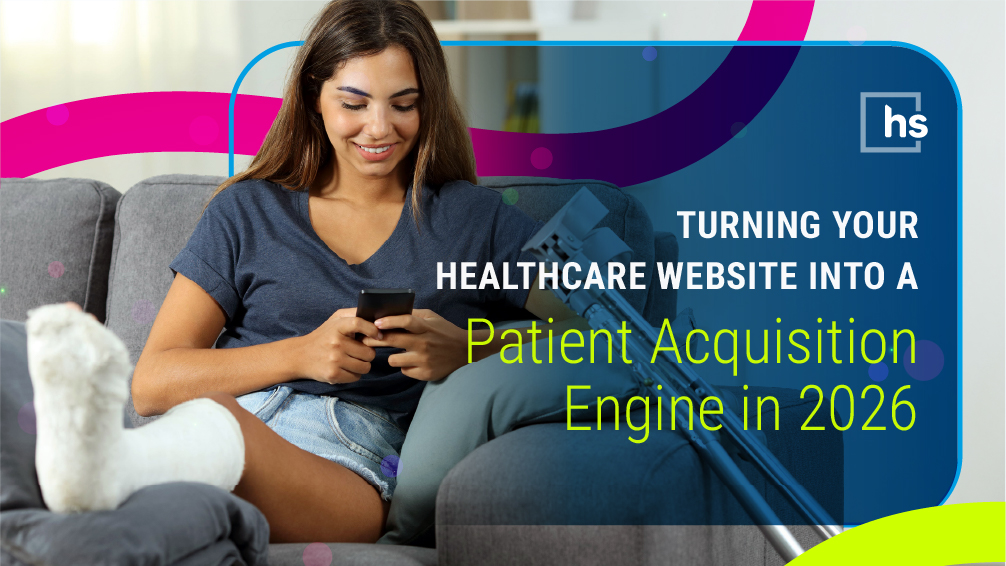
Turning Your Healthcare Website into a Patient Acquisition Engine in 2026 (Executive View)
Most healthcare organizations still treat their websites as brochures. It “looks fine,” but leaks high‑value patients daily. The irony: you may do the hard work—investing in SEO, Google Ads, traditional media, and brand—but lose the payoff at conversion.
In 2026, that’s no longer a rounding error. AI‑driven search, paid, and word‑of‑mouth now funnel demand to one digital front door. Any website or scheduling weakness will cap growth—no matter how strong your upstream marketing is. Google’s Core Web Vitals research shows faster, more stable page experiences lead to lower abandonment and higher engagement.
Conversion rate optimization (CRO) improves the last mile so more of the right visitors become inquiries and patients. You don’t need to be a CRO scientist to fix obvious leaks.
This article is Part 3 of 11 in our AI‑Era Healthcare Website Playbook.
Why great traffic still fails
Over the years, I’ve noticed a pattern: most teams obsess over just one piece of the growth puzzle—usually media or “the campaign in the machine”—and under-invest in what happens after a click or a call. That’s why I wrote Four Vital Optimizations Required for Digital Marketing Success: consumer demand, campaign management, landing page, and conversion process. Each is equally important, and they compound.
The key idea is simple but brutal: these four variables multiply, not add. If any one of them is effectively a zero, your overall results are zero. You can have solid consumer demand and great Google Ads management and still get nothing to show for it if your landing page or conversion process fails. A weak page or clumsy scheduling experience can erase the value of excellent SEO or paid search in an instant.
You’ve probably seen this firsthand. Campaigns drive high-intent visitors, but they land on a generic service page—vague copy, no proof, and a hidden “Contact Us” form. Worse, they take action only to reach an untrained front desk, a phone tree, or voicemail. In both cases, the marketing “worked.” The acquisition engine failed at the exact moment patients wanted to move forward.
What a patient acquisition engine actually is
A patient acquisition engine is not a prettier brochure. It’s a website and surrounding process deliberately engineered to turn the right visitors into inquiries, booked appointments, and downstream revenue.
At a minimum, it gets three things right:
- It attracts the right traffic: people in your geos with the right clinical needs and payer mix.
- It matches the message to that intent: each key page has a clear job and speaks directly to what that visitor is trying to decide.
- It makes conversion easy and reassuring: explicit next steps, low friction, and a strong, patient‑centered scheduling experience.
When those three pieces are in place, your website stops behaving like a cost center and starts acting like a measurable acquisition channel. Key takeaway: With strong traffic, message alignment, and easy conversion, your website delivers real patient growth.
Start with the right visitors, not just more visitors.
The first job of an acquisition engine is to bring in the right people, not just more people. In healthcare, traffic quality is everything. It makes no sense to optimize conversion on visitors outside your service area, payer strategy, or clinical scope.
That’s why this work starts at the top of the funnel:
- Align SEO and paid search around your highest‑value service lines, procedures, and locations.
- Tighten geo‑targeting and audience filters so you’re not paying to reach people you can’t serve well.
- Recognize how AI‑influenced search results and answer experiences change which pages get surfaced. Consider what new questions they must answer when patients arrive.
Once you know you’re bringing in the right visitors, everything else in this post is about what you do with that opportunity. Key takeaway: Conversion potential depends on acting effectively once you have acquired the right audience.
Message match: align page intent with patient intent
One of the fastest ways to improve real‑world results is to clean up message mismatch. If a person clicks an ad for “same‑day orthopedic urgent care in Chicago,” they shouldn’t land on a generic “About Our Health System” page.
Strong message match looks like this:
- Each high‑value page has a single main job. It might educate about a condition, explain a service, highlight a location, or introduce a provider—not all at once.
- Headlines, subheads, and proof points all reinforce that job and echo the language that brought the visitor there.
- CTAs match intent: “Schedule a consultation,” “Find a nearby location,” or “Call to discuss your options,” instead of a generic “Contact us.”
Here, you’re reducing cognitive friction. The visitor should never have to ask, “Am I in the right place?” or “What am I supposed to do next?” Key takeaway: Clear direction eliminates confusion and drives action.
Conversion architecture: design the paths; don’t hope for them
Too many healthcare sites treat calls, forms, and online scheduling as incidental. In a true acquisition engine, they’re the main event. You design clear, obvious paths instead of hoping patients will figure it out.
McKinsey research shows that healthcare consumers increasingly expect convenient, digital-first access to care—including online scheduling and explicit next steps.
A few practical moves:
- Put primary CTAs where the eyes naturally go: above the fold, mid‑page near key proof, and at the end of the page.
- Offer multiple, clearly labeled options when appropriate: “Call now,” “Schedule online,” or “Request an appointment,” with expectations on response time.
- Strip friction out of forms: fewer required fields, mobile‑friendly layouts, and clear comfort regarding privacy and follow‑up.
On the technical side, page speed, mobile UX, and accessibility aren’t just IT concerns. Slow, clunky, or confusing pages cause anxious patients to drop off.
Trust signals that de‑risk the decision.
Healthcare decisions are high stakes. Patients aren’t buying running shoes; they’re deciding who to trust with their health or their family’s health. Your acquisition engine has to de‑risk that choice.
Strong acquisition pages typically include:
- Social proof: outcomes, testimonials, reviews, and case stories (structured and compliant).
- Professional credibility: experience, volumes, subspecialty focus, affiliations, and recognitions.
- Practical proof: convenient locations and hours, clear insurance messaging, and specifics on access (same‑day/next‑day, virtual visits, etc.).
The goal is not to brag. Instead, aim to clearly address a patient’s main questions: "Can I trust you?" "Can you help with my specific problem?" "Is this going to be a hassle?" These are the key takeaways to keep in mind.
Metrics and basic conversion rate optimization
You can’t call a website a patient acquisition engine if you only measure sessions and pageviews. You need to track what happens when real people try to become patients. This is where some basic conversion rate optimization thinking pays off. Key takeaway: Prioritize metrics that reflect real patient acquisition progress.
At a minimum, you should be watching:
- Conversion rates by page and channel: calls, forms, online bookings, and even high‑intent actions like “find a location.”
- Lead quality: how many website‑generated inquiries turn into kept appointments and downstream revenue.
- Speed‑to‑lead: how quickly calls are answered, and forms receive a meaningful response.
If you’re comfortable with it, you can borrow one more page from conversion rate optimization and do simple A/B tests on high‑value pages—different headlines, proof blocks, or form layouts—to see what actually moves the needle.
Your conversion process is part of the engine.
The last—and often weakest—link in the chain is the human conversion process. You can do everything right online and still lose if calls and forms are mishandled. This was one of the central points in Four Vital Optimizations Required For Digital Marketing Success: if the conversion process is zero, overall results are zero, regardless of how good your media and landing pages are.
Treat your front‑end operations as part of the patient acquisition engine:
- Decide where calls and digital inquiries will be handled—local office, centralized access center, or a hybrid model.
- Train specific people to convert inquiries into appointments using clear scripts, effective objection handling, and empathy.
- Put systems in place so no lead slips through unnoticed: call tracking, CRM, logging, and fast follow‑up, including after‑hours strategies. Research published in Harvard Business Review found that companies that respond to inquiries within an hour are dramatically more likely to qualify and convert leads than those that wait even a few hours.
In other words, your “landing page” doesn’t end at the form. In healthcare, the real conversion often happens in that first live human interaction. Key takeaway: Human follow-up is crucial for successful patient acquisition.
Next steps: from brochure to acquisition engine
If your website acts more like a brochure than an acquisition engine, you don’t need a total rebuild. Start by focusing on the most important moments.
- Identify the 3-5 highest‑value pages for your top service lines and locations.
- Diagnose traffic quality, message match, and conversion friction on each.
- Make targeted changes, baseline your metrics, and test your way to better results. Key takeaway: Small, focused improvements yield measurable growth over time.
If you’re already investing in SEO, paid search, and brand, this is where your next major wave of growth is hiding. When your website, landing pages, and conversion process all pull in the same direction, you don’t just get more visits—you get more patients. Key takeaway: Aligning digital efforts amplifies your patient acquisition results.
More Reading
This article is Blog 3 in our 11-part Healthcare Website in the Age of AI series:
- Your Healthcare Website in the Age of AI: The New Epicenter of Growth
- Patient-first UX and Design That Reduces Anxiety in 2026
- Turning Healthcare Websites into Patient Acquisition Engines
- AI-Era SEO and Content Architecture for Healthcare Websites
FAQs: Turning your website into a patient acquisition engine
Q: How is a “patient acquisition engine” different from a normal healthcare website?
A patient acquisition engine is built to turn qualified visitors into inquiries and appointments, with clear paths, proof, and strong scheduling, while a typical site mainly shares information and hopes people will call.
Q: Do we need a full rebuild to improve results, or can we optimize what we have?
Most organizations can make meaningful gains by improving their highest‑value existing pages—tightening message match, CTAs, forms, and scheduling processes—before they ever commit to a full redesign.
Q: Where should we start if we’re already investing heavily in SEO and paid search?
Start where the money is: service‑line and location pages that receive high‑intent traffic, then fix obvious friction points and measure conversion lift rather than adding more media spend.
Q: How sophisticated do we need to be with conversion rate optimization?
You don’t need a lab; a simple discipline of tracking key conversion metrics and running a few basic tests on high‑value pages can reveal easy wins and prove the business case for deeper optimization.
Subscribe for More:
Don’t miss future insights—subscribe to our blog and join us on LinkedIn: Stewart Gandolf and Healthcare Success.