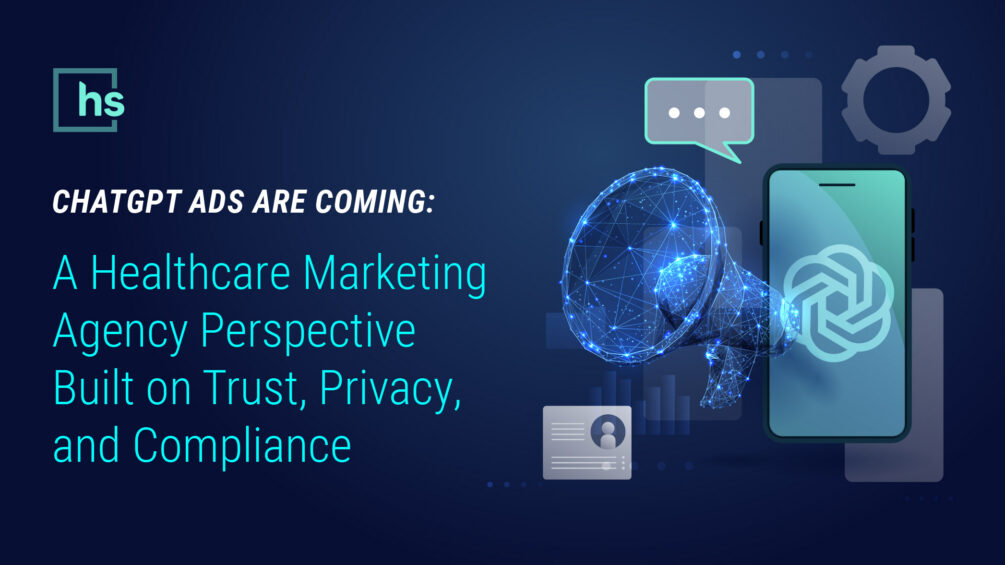
ChatGPT Ads Are Coming: A Healthcare Marketing Agency Perspective Built on Trust, Privacy, and Compliance
OpenAI has announced plans to begin testing ads within ChatGPT for logged-in adult users in the United States on the Free and Go tiers. According to OpenAI, ads will be clearly labeled, visually separated from organic answers, and shown only when relevant to the user’s conversation—initially appearing below responses.
For healthcare organizations, the most important takeaway is eligibility and adjacency.
OpenAI has stated that ads will not be eligible near sensitive or regulated topics, including health, mental health, and politics. As a result, many healthcare advertisers should expect limited or no inventory during early testing.
Even so, this development matters. It signals the emergence of a new “answer moment”—a space where consumer decisions are shaped within AI-mediated conversations rather than through traditional search results or social feeds.
Over the long term, while the opportunities may prove to be substantial, potential conflicts of interest must be avoided. Anthropic’s Claude underscored this risk in its Super Bowl ad, explicitly rejecting ads inside sensitive conversations—including health questions—as inherently misaligned with user trust. That critique resonates in healthcare: If AI assistants are going to mediate life‑impacting decisions, their answers cannot be distorted by ad incentives, even when no PHI is technically in play.
Healthcare Success’ position is clear:
If advertising inside AI assistants is going to be effective in the long term, it must be trust-first by design. For healthcare brands, that standard must also be privacy-first and compliance-forward, even when the platform itself is not processing protected health information (PHI).
What OpenAI Has Publicly Confirmed
(What we know—not speculation)
Based on OpenAI’s announcements to date:
- Testing scope: Initial testing is planned for logged-in adult users in the U.S. on Free and Go tiers. Higher tiers are expected to remain ad-free.
- Placement and labeling: Ads will be clearly labeled, visually separated from organic answers, and initially shown below responses when relevant.
- Sensitive adjacency limits: Ads will not be eligible near health, mental health, or political topics during early testing.
- Privacy posture: OpenAI has stated that ads will not influence answers and that conversations will not be shared with advertisers.
These guardrails are especially important in a personal assistant environment—and even more so in healthcare.
Why This Matters Even If Healthcare Ads Are Restricted at Launch
1. The “Answer Moment” Is Becoming Monetizable
ChatGPT sits closer to decision-making than most digital environments. Users ask direct, high-intent questions—comparisons, recommendations, costs, and next steps—in natural language.
By introducing ads as a clearly separated layer, OpenAI is signaling that monetization will occur around answers, not inside them. For healthcare marketers, this reinforces a critical reality: Visibility is increasingly determined by credibility and clarity, not just bids and budgets.
So rather than simply wait for ChatGPT advertising to become available in healthcare, we strongly recommend our clients double down on building organic traffic from ChatGPT, Google AI Overviews, and other LLMs. (Potential pull quote)
2. Healthcare Marketing Will Be Pressured to Become More Transparent
As AI-mediated journeys expand, healthcare consumers will expect:
- Clearer explanations of eligibility, coverage, and access
- Less lead-generation friction and more patient-first clarity
- Stronger proof, outcomes language, and appropriately qualified claims
AI environments reward specificity and trust—not vague promises or marketing gloss.
3. The Near-Term Strategy is to Focus on “Earned Answers,” Not Paid Placements
If paid inventory remains limited for healthcare categories, the advantage shifts toward organizations that demonstrate authority organically, without advertising:
- High-quality, authoritative content
- Consistent claims supported by citations
- Strong reputation signals (reviews, directories, affiliations)
- Landing pages that answer questions quickly, clearly, and safely
In other words, being the best answer may be free and matter more than buying placement.
Our Healthcare-Specific Position: Trust-First, Compliance-Forward
OpenAI has emphasized that user trust is foundational to advertising inside a personal assistant experience. In healthcare, “trust-first” cannot be a rhetorical phrase—it must be operational.
Our Principles
- No PHI targeting. Ever.
- Consent-first measurement. If a user becomes a prospective patient, measurement must follow consent and minimum-necessary data handling.
- Truth over hype. Healthcare claims must be specific, sourced, and appropriately qualified.
- Brand safety as a clinical standard. Placement adjacency and creative language are treated as risk controls, not afterthoughts.
The HIPAA Reality Check (What This Means for Agencies and Healthcare Brands)
Even if ChatGPT Ads never directly touch PHI, healthcare marketers still carry HIPAA-grade responsibilities throughout the rest of the funnel.
What We Will Not Do
- Use PHI in ad targeting, segmentation, or optimization.
- Implement tracking that transmits sensitive health information through advertising platforms.
What We Will Do: HIPAA-Safe Growth
- Deploy HIPAA-conscious analytics: consent controls, data minimization, and server-side governance.
- Optimize toward privacy-safe conversion signals (e.g., scheduling completion, call connection quality, qualified intake milestones)
- Maintain strict separation between marketing analytics and PHI, with appropriate BAAs where required.
What Remains Unknown—and What We’re Watching
OpenAI has not yet publicly detailed advertiser controls, bidding models, attribution depth, or whether restrictions for regulated categories will evolve.
For healthcare, we are closely watching:
- Whether “health adjacency” restrictions become more nuanced over time
- Whether certain categories (e.g., insurance, wellness, non-clinical services) become eligible
- What auditability exists for placement context and policy enforcement
- How the public reacts to paid advertising in ChatGPT, and how ChatGPT stays within ethical and legal boundaries.
- Ethical guidance from relevant healthcare authorities.
Our Recommended Client Plan: Build AI Answer Readiness Organically (For Now)
1. Build an “Answer Footprint”
- Condition-agnostic FAQs (process, cost ranges, safety, licensing, what to expect)
- Service and facility pages that clearly explain fit, exclusions, and next steps
- Third-party credibility signals: directories, reviews, publications, partnerships
2. Upgrade the Conversion Experience
- Immediate clarity above the fold (who it’s for/not for, insurance, location, wait times)
- Trust blocks (credentials, accreditation, privacy commitments, patient rights)
- Low-friction scheduling and calls with compliant disclosures
3. Measurement That Survives Scrutiny
- Conversion taxonomies built around privacy-safe milestones
- Offline outcome feedback loops (qualified consults, qualified intakes, admits where applicable) without passing sensitive data into ad platforms.
Closing Perspective
ChatGPT Ads are not “just another placement.” They represent a shift toward marketing inside the decision-support conversation itself.
For healthcare organizations, the bar is higher. Trust, privacy, and compliance are not constraints—they are the strategy.
OpenAI’s early stance—clear labeling, separation from answers, and restrictions near health and mental health topics—is the right direction. Over time, the market will reward healthcare brands that act like they deserve recommendation, not just attention.
FAQs
A. What is Healthcare Success’ stance on ChatGPT advertising?
“As a healthcare marketing agency, we support advertising models that protect user trust and privacy. If ads appear in AI assistants, they must be clearly labeled, separated from answers, and avoid exploitative or sensitive health contexts. Our focus for clients now is building organic visibility and AI Answer Readiness—being the most credible, transparent, and patient-first option, whether or not paid inventory is available. As paid models evolve and become available for healthcare, we’ll recommend clients test them only after we are convinced they meet ethical and privacy standards.” –Stewart Gandolf, CEO, Healthcare Success
B. Can healthcare brands advertise in ChatGPT?
Early testing excludes health and mental health adjacency, so most healthcare campaigns may not be eligible at first.
C. Will ChatGPT replace Google Ads?
No. Think of ChatGPT as a new opportunity organically and eventually for advertising, not as a replacement channel.
D. What should healthcare organizations do now regarding ChatGPT ads?
For on building your organic presence by improving content and conversion experiences that both AI systems and patients trust—and ensure measurement remains privacy-safe.