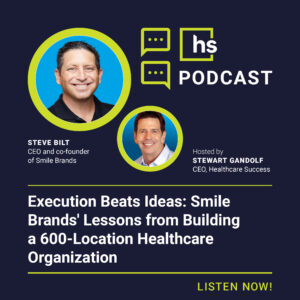
Execution Beats Ideas: Smile Brands’ Lessons from Building a 600-Location Healthcare Organization








What separates healthcare organizations that scale successfully from those that struggle?
According to Steve Bilt, CEO and co-founder of Smile Brands, it's rarely a shortage of ideas. More often, success comes down to disciplined execution, leadership alignment, and the ability to make pragmatic decisions amid constant change.
In this episode, Stewart Gandolf sits down with Steve to discuss the realities of building and leading one of healthcare's largest multi-location organizations. Over the past 25 years, Smile Brands has grown to more than 600 locations serving approximately three million patients annually. Along the way, the organization has navigated workforce shifts, technological disruption, private equity partnerships, acquisitions, operational complexity, and rapid industry change.
A central theme of the conversation is alignment. As organizations grow, leaders must ensure that boards, executives, operators, clinicians, marketers, HR teams, finance teams, and frontline staff understand not only what the organization is trying to accomplish, but why it matters. Without that shared understanding, even strong strategies can lose momentum.
Steve shares a practical leadership philosophy: "Keep your head exactly where your feet are." Rather than chasing every new trend or shiny object, leaders must remain honest about their organization's current capabilities while continuously making incremental improvements. That mindset applies equally to AI adoption, acquisitions, culture-building, operational transformation, and long-term growth planning.
The discussion explores why many organizations struggle with alignment, how leaders can evaluate new technologies without becoming distracted by hype, and why pragmatic leadership often outperforms grand visions that lack operational reality. Steve also discusses lessons learned from years of acquisitions, private equity partnerships, organizational restructuring, and scaling complex healthcare businesses.
Topics include:
• Creating alignment between boards, executives, regional leaders, and frontline teams
• Why disciplined execution matters more than great ideas
• The role of culture in multi-location healthcare organizations
• How successful organizations evaluate growth opportunities and acquisitions
• Leadership lessons from private equity-backed healthcare companies
• AI, innovation, and avoiding the "shiny object" trap
• Building sustainable value in DSOs and other healthcare organizations
This episode was inspired in part by the Association of Dental Support Organization's (ADSO) recent efforts to expand engagement opportunities for senior leaders across the DSO community. As healthcare organizations continue to evolve, conversations like this help executives compare notes, share lessons learned, and better navigate the challenges ahead.
Learn more about ADSO conferences, industry resources, and member benefits at TheADSO.org.
Why Listen?
In this episode, listeners will learn:
• Why team alignment is essential for scaling multi-location healthcare organizations
• How healthcare leaders can balance innovation with operational discipline
• Why technology adoption, including AI, must be grounded in workflow and organizational readiness
• How culture is built through repetition, consistency, and authentic leadership
• What healthcare executives should consider before pursuing acquisitions or rapid expansion
Key Insights and Takeaways
- Peer learning becomes more valuable when it reaches functional leaders. CEO-level relationships remain important, but organizations benefit when CMOs, HR leaders, operators, and other executives compare practical lessons with peers facing similar challenges.
- AI and technology adoption require pragmatism. Healthcare organizations should avoid chasing every new tool. Leaders need to assess workflow fit, data readiness, patient affordability, workforce adoption, and infrastructure before committing significant resources.
- Board alignment depends on honesty about the current state. Ambitious growth stories are useful only when paired with a clear understanding of where the organization is today and what incremental improvements are realistically underway.
- Misalignment often begins with a one-sided mindset. Steve emphasizes the importance of beginning conversations by identifying how both parties win, whether the counterpart is a provider, investor, supplier, employee, or patient.
5. M&A discipline requires knowing where your organization truly adds value.
A deal that looks attractive financially may still be wrong if the operating model, provider transition, or cultural expectations don't fit the buyer's capabilities.
6. Culture is built through repetition, not aspiration. Mission statements matter, but only when leaders reinforce them consistently through daily communication, behavior, and decision-making.
7. Scale alone is no longer enough. Multi-location healthcare organizations must prove they can grow faster than the market, operate more efficiently, improve retention, and create a better experience for patients and providers.

Steve Bilt
CEO and Co-Founder, Smile BrandsFor more information about the Association of Dental Support Organizations (ADSO), visit www.theadso.org.
Subscribe for More
Don’t miss future insights—subscribe to our blog and join us on LinkedIn: Stewart Gandolf and Healthcare Success.
Note: The following AI-generated transcript is provided as an additional resource for those who prefer not to listen to the podcast recording. It has been lightly edited and reviewed for readability and accuracy.
Read the Full Transcript
Stewart Gandolf (Healthcare Success): Welcome to the Healthcare Success Podcast. Today I am pleased to interview Steve Bilt, who is CEO of Smile Brands. First of all, welcome Steve.
Steve Bilt (Smile Brands): Thank you, Stewart. I appreciate it. It's good to be here.
Stewart Gandolf (Healthcare Success): I think this is going to be truly fun, Steve. I hope you agree. We'll see at the end of this, and I hope the audience does as well.
So I've had the pleasure to meet Steve through a mutual friend of ours, Matt Hall, who's introduced me recently, and also Andrew Smith with ADSO. And so today we're going talk about teamwork and why it's so important with a multi-location provider, be it dental, it could it be medical or any other profession or hospital.
The idea of the throughput coming from the leadership down to the actual ground working with the troops, right? And so that really is a big part of the summit this year at ADSO. So first of all, Steve, I'd love to, since you know a lot of our listeners may know you, but some may not, give a quick background on you know what you're doing over at Smile Brands, and then we'll talk a little about ADSO and what generated this topic to start.
Steve Bilt (Smile Brands): So I was a co-founder of Smile Brands 25 years ago now. So it's been quite a quite a journey. And you know, we started out in a in a small space that really hadn't defined itself. It wasn't called the DSO space at the time, but the idea was that half the country wasn't in regular care, that dental similar to medical was becoming more and more complicated and that there had to be a way to allow providers to be more patient-facing. There had to be a way to help attract more patients for those providers. Then there had to be a way to do a better job supporting them administratively because dentists were spending 40%, 45% of their time on administrative matters versus being able to focus almost exclusively on patient care.
So we started a business way back then with a pretty simple premise, turned out to be a lot more complicated than when we set out, which is probably everyone's business. You know, it just works out that way. I'm fond of saying everyone else's business looks easy. Which I think from the outside before you're into something, it tends to be true. And then you get in and you realize, you know, why it's so difficult.
Now, that being said, if it was really that easy, it would commoditize completely very quickly. So it's nice those complexities are actually your friend, but they're not so easy to embrace and some days harder to embrace than others. But we've been on this journey for, like I said, you know, two and a half decades, and we've grown to a coast to coast business, 600 plus locations. We take care of about three million people a year. And on top of that, we've layered over the largest dental foundation in the world, charitably that we use to provide care in 12 countries around the world.
So it's been a fun journey. The challenges never cease. And you know, they're probably greater today than they've ever been. I have a whole ‘nother philosophy on why it feels that way that we can get into later. But it's but it's been a great run and you know, lots of opportunities to reinvent the business every day. And I think those are where value's created, and so we're you know really thrilled to be at it, excited about the business.
And certainly not feeling like there's any shortage of challenges these days. That is that is they're abundant.
Stewart Gandolf (Healthcare Success): ⁓ I love the comment. Like everybody else's business seems so much easier. I have have a brother in law that owns a landscaping business and I think, “your business is so much easier.” And it's like, you don't know So ⁓ and I feel humbled. Six hundred and fifty locations is I think I like to think I've got a pretty large agency, but six hundred and fifty locations is a lot. So congratulations to you. I'm really impressed by that track record. That's amazing. And ⁓ actually a short period of time to do so much. It's ⁓ you must feel pretty good about yourself there.
So you know, we talked about at the very beginning opening, ADSO has a summit this year. And ⁓ when I met Andrew a couple weeks ago, he mentioned that this year it's gonna be about teamwork and you know the official line is bringing together matters, building together multiplies impact.
So what is talk about the leadership teams and you know how the why that is so important and why alignment can be so challenging, 'cause I think this applies to DSOs, but really any complex provider business or even non providers we have listening as well.
Steve Bilt (Smile Brands): Well, you know, we founded ADSO again under a different name, you know, 20-something years ago. And it was it was really an accumulation, just an opportunity for really quite nascent CEOs in a in a young space to get together just to talk about what we were up against, what we were dealing with. And at the time, you know, none of us really had much crossover in terms of the markets we were in.
But that really doesn't even matter because, you know, like I joke sometimes about my confidential business plans. I'm like, boy, “yeah, go ahead and leak those because I can barely execute the damn things, let alone, you know, anyone else,” right? And so there was an opportunity to get together and just share what we were doing and what we were experiencing, what was working and what wasn't.
And some of it was just commiserating on the challenges in the space to know it wasn't us. It was just the reality of trying to operate in this sector.
But others were really you know, interesting kind of breakthrough ideas that you could never execute the same way in another company, but the thread was there to be helpful. And probably more important than anything else, just the relationships were helpful. So those are very close relationships today for me. You know, whether that's, you know, Rick Workman or Bob Fontana or Steve Thorne or any of those people that we kind of started this group with, they're valuable.
And what and that was really a hallmark of ADSO over the years was the fact that we had these relationships and could share ideas. And as the companies have become bigger and everything we do as leaders is really executed through others, and it might be executed through others in three or four layers, that starts to develop this critical nature of your own team. But then it's also this critical element of how is your own team connected to the sector.
And so we really wanted this year from an ADSO perspective, and really just from any sector's perspective, is to say, let's make sure our teams are developing those cross-team relationships with others in the space so that they can be force multipliers on what I was describing about the early days of ADSO and the CEOs getting together. The value of, say, me getting together with all the other CEOs still exists.
But to think that I'm gonna go back to my organization and translate all those lessons and then have them execute them without really the benefit of having the firsthand experience is probably unrealistic. So what we're trying to create is more of a firsthand let CMOs get together with CMOs and let CHROs get together with CHROs and let operators get together. And again, you're not sharing proprietary ideas per se. You're really sharing concepts on what's happening, what challenges you're facing. So you can round out your own experience in your company with what's happening in others.
And that that was really the goal or is the goal of of this year's ADSO summit. And I think it's something that all the sectors out there should be thinking about.
Stewart Gandolf (Healthcare Success): I think it's really intriguing. There's a couple things you just said that caught my ear. One was, you know, in a way, you're getting you're all getting together to share ideas, and you guys are competing in different marketplaces. So there's that.
But another thing you said that's really important, and I think this is vital, is execution is everything. Earlier in my career, I used to think of myself as an idea guy, and I still am. I like being an innovator. I love new ideas. And I completely, Steve, missed the boat on how important execution is.
It's a blind side for me. It's like, you just go do it. I came up with it. You guys do it. And I've done personality traits. My favorite was ⁓ if you've ever done like the DISC, I'm a high D, high I. And this guy said, “You are an arsonist. You set fires and you expect everybody else to put them out.” It's like, “yeah, kinda, that's it.” So I really mis ⁓ underestimated execution. Love your comment on that since you brought it up, first of all, just in terms of the executional side of this.
Steve Bilt (Smile Brands): It is it is such a in critical unique idea people, but you know, I I'm fond of saying the first casualty of war is always the plan, which is not my thing, but you know, it really is what happens, right? You can develop the greatest plan, then you take it out to the real world and you know, it blows up because it involves other people. And then there's this incredible skill that goes with fine-tuning and shaping and molding, you know, that clay into something that works, right?
And so I just think you get together with competitors, you're sharing ideas, you're sharing something that feels you know proprietary. It's really not proprietary because it doesn't execute the same way in your business as it does in their business. And then you really think about your plans and what you're doing today.
What were you doing a year ago and how different was it? And how much have things changed, you know, since then? How much have you had to refine to make it actually work? And so you're not giving away the formula for Coca-Cola here. You're giving away something that has to be operationalized in a different market with different people, with different technologies, with different paths through history. You know, you're helping each other, but you're not giving each other the secret formula. It's just not there is nothing in a service business.
Stewart Gandolf (Healthcare Success): I get it. And the other thing you said that I thought was really intriguing was the history of doing this for twenty-five years and you have a bunch of CEOs and know each other. And again, I just think about it in my own agency. Going back and telling my team something I learned from a conference is kind of impossible. And you guys are doing it with six hundred and something locations. Like I could see why that would be just a monumental task. Because from out to it's like what happened yesterday is something there's always something that's gonna make me late to a meeting or whatever. So execution is huge.
So tell me like ⁓ you know, this is ⁓ new apparently for you guys doing it this way. Like thinking of Smile Brands in particular, what are some of the things you're most excited about? Giving your some of your other senior leaders context for how you see the world and where do you see this going?
Steve Bilt (Smile Brands): Well, you know, part of it is like the workforce has changed tremendously in every sector in the last five years. You know, especially with this exponential pace of change in terms of the way people approach their jobs, what they're looking for, what's motivating, how they connect to an organization. And I think comparing notes around that is huge, right? So I think that's a big deal all by itself.
Then you take that, and we're a you know, we're a people-based business. So that's huge. That you know that would have been enough, right? But now you say, you know, dentistry in our case was a pretty slow-moving profession. One of the things we liked about it, I my start was in finance. One of the things you liked about it is the technology was moving so slowly that you didn't have to necessarily eat a bunch of capital keeping up with the tech curve.
Well, has that ever changed, right? I mean you look now at the pace of innovation in the space, whether it's radiographic AI, whether it's you know, agentic AI to do you know back office tasks, whether it's the you know CBCTs, it just goes on and on in terms of the pace of change in the sector. And this tech curve, you know, you look at it and you go, “Well, this is wonderful. Except if I, you know, went and took up every tech product I was offered or just a piece of it, you know, in every category, you know, I could spend, I don't know, 150% of revenue on my tech stack,” right? It doesn't exactly work.
So what does work? What do people embrace? What fits the workflow of, you know, this, like I mentioned, the workforce changing, you know, their mindset. ⁓ you know, what works in the context of that workforce? How much change is too much change? How have you uptake change and how much time do you give it to stick? And do you try multiple things at the same time in different places in your organization? Do you do it all for one where you roll it out in its entirety and everybody gets the same experience?
So there's just an incredible learning opportunity because so much has changed so fast and so much is coming at us on a rapid basis that you and by the way, how much can the consumer handle? Right? Because if they were spending $1,000 at the dentist, and now you go, well, there's great opportunity, and now they can spend $2,000. You say, great, except they only have $1,000. So is it really going to get taken up or not? And so like there's lots of these just lessons and learning, and no one has the answer anyway. So you think about these questions, they're not quite rhetorical, but they're also not, they don't have a binary answer either.
Right? So it's somewhere between rhetorical and binary where you're saying, let's compare notes on these things and see if we can both learn. And then you're not gonna really draw to a conclusion because the answer might be different in parts of your company. It might be different in your company compared to their company.
But you are brainstorming and sharing information and developing relationships and then go on that journey, each of you in parallel, not together per se, but in parallel, then you can come back and compare notes again. How is that going for you? And are you is that working? And then you're able to be smarter together because of that, is what I think is the exciting opportunity around it, right?
Stewart Gandolf (Healthcare Success): That makes total sense. And I can see the need for you know, peer ⁓ I guess validation, right? Like how did that work in the real world? I heard the theory last year, how did it actually work out? It's gotta be super big.
And just as an aside, I'm really having a lot of fun with some of the advanced AI programs, just doing things like, “Okay, is it me or does this make sense?” And in a way you're tapping into the broader world, right?
I had a somebody question a very simple contract we have at an entry level. And the questions they asked me were like, ooh, I don't know. This scares me a little bit because like if they're asking these questions already, what's this going to be like? And so I was able to actually run into the machine and get this. And so we have our you know people and our team members for context, but I think even the machines are helping with that as we go forward. So it's really interesting.
So pivoting down to the next thing, the ⁓ when you're looking at this alignment between in for successful DSOs and your own and as well as your peers, how does that alignment work in the robot between the board to C-suite down to regional managers, practice level managers, the dentists themselves, dentist owners, like how does that all work? And it feels like I'm gonna throw in a word culture. I don't know how much that's driving it, but operationally, culture, how does that all work together?
Steve Bilt (Smile Brands): Well sometimes really well and sometimes really poorly. It would be the short answer. You know, but the there it's interesting, I was I think about this one a lot, right? Because you have such a massive curve. And I'm old enough to have been through the dot com boom as a CEO, right? So there was a period of time when you're like, “Well, I can make my company worth three times as much if I just call it dot com,” right?
So if I was smilebrands.com, I'd be worth a fortune compared to just being SmileBrands. And it feels a little bit like that again, where like if you can say “I'm AI driven, I'm AI, this,” then boy, you're gonna be worth a ton, right? So it's very tempting to go after these shiny objects in a huge way to say, well, “we're the most AI-driven dental company in the world, and therefore we're gonna be worth a ton.” You know, and you talk about alignment, and what triggers me around this is there's a runner's mantra that says keep your head exactly where your feet are.
And it's really kind of one of those things that tries to help you as a runner when you're trying to make progress not think so much about how much road is ahead of you and let your mind get overwhelmed, and just figure out where your feet are and keep your brain there and just stay with the pace. And so if you think about that, and say, you know, you want to go to your board and you want to say, “wow, we're so AI-driven,” and you start explaining how you're gonna be this AI-dominated company. And they're looking at you going, like, “you don't even use it yet. And if you did, you'd be doing very pedestrian things first.” And then you create this misalignment because they kind of know you've lost track of where your feet are at the moment. So I do think alignment has a lot to do with pragmatism.
Where are your feet right now? What is our current situation? And you know, if you're like Smile Brands, you got some tech debt. And your data's not perfectly aligned. And you're doing some work to homogenize our ERPs across the company. You know, and there's all these things going on that are infrastructure projects that are not sexy at all. They set you up for big opportunities in the future, but you're gonna have to stay in this moment, keep this, you know, six and a half minute mile pace or whatever the hell you're running, and just keep going down the road for a while before you're ready to break through.
And so there's that alignment, and I've spent a lot of I've been, you know, PE backed for a long time, multiple, multiple firms. And so, you know, I have spent a fair amount of time thinking about this. How do you stay aligned with a board? How do you stay aligned with your investors? And a lot of it is the pragmatism to be candid and clear about where you are right now and what you're doing to get incrementally better.
It's incredibly important for a board and candidly for a company to know “I'm gonna be a little better tomorrow than I am today. And a year from now, I'm gonna be incrementally better.” That's very different than where you might want to take it eventually, right? You might eventually say, “I've got huge opportunities here to drive this company to five times the size, 10 times the size.” But if you're talking about that only, and not acknowledging the reality of what the experience is today, and that should be for all your constituents. What's the experience like for your patients today? And you should be measuring that.
We do it through NPS. What's the experience like for your providers today? Measure it. What's the experience like for your employees? What's the experience like for your vendor partners or your suppliers, right? What's the experience like for your investors? How do you guys feel about this, right?
So being practical and pragmatic about that is critical versus being very pie in the sky. I actually think more C-suites fall because they're not being pragmatic about where they are today and making incremental improvement and focusing too far afield at big massive initiatives that a board could look at and say, “well, that'd be great if it happened, but I have no I don't have a lot of confidence that it's gonna happen,” versus, “this isn't transformational improvement, but I sure know if I stick with this team, I'm better off a year from now than I am today.”
So I think that's a there's a pragmatic or a maturity that goes with that without losing sight of the fact that you ultimately have to say, how do I create value for my constituents? And if it's your investors, you might have to do some big things in the dental space or the ⁓ provider space or, you know, any healthcare space right now. There's a lot that has to happen.
But that incremental or pragmatic approach I think is the first step to getting alignment. Because if people don't think you're practical, you're not gonna get aligned on the other stuff, right?
Stewart Gandolf (Healthcare Success): That totally makes sense. And you used a line it's so funny. You're using words that I say. I talk about shiny lights all the time. I think of the scene from Finding Nemo when they're going down the abyss and seeing the anglerfish. Like “I feel happy.” And my former partner and I used to call this one guy we met shiny lights because I just felt like we're going down the abyss if we keep down that path. It's really easy for me to be suckered by shiny lights and charisma.
And I've learned though, Steve. I'm better than I used to be. I'm definitely better. ⁓
So speak it's a it's a lifetime journey. So I'm curious for multi-location businesses, dental or otherwise, where do where does misalignment off most often show up? Is it strategy? Is it operations, clinical, finance, marketing, HR? And what are some of the consequences of that misalignment?
Steve Bilt (Smile Brands): You know, it's a good question. And I think it first and foremost shows up in a category or a mindset. And that's like walking to a meeting with you and saying, “Stewart, let me tell you what I need from you. Let me tell you what you can do for me.” And you know, I don't know if you remember long, long time ago, Al Franken when he was a comedian was was on Saturday Live going, “I bet you're wondering what you could do for me, Al Franken.” And he goes, “You can buy this Al Franken commemorative coin. All proceeds to me, Al Franken.”
You know, and it's kind of like CEOs walk into rooms oftentimes with constituents, and basically, let me tell you what you can do for me. You know, and that's a bad start. So we try historically to start every meeting with our three-word vision statement, which is “smiles for everyone,” and link how this meeting relates to smiles for everyone. How's it going to make you win? How's it going to make me win? Both of us. Not an either or.
And that that's probably number one in terms of mistake and misalignment that occurs. Because you know what'll you know how you know probably what it takes to make you happy and what you need, but why would the other person, your counterpart, want to do that and yet to start in their shoes and say, let's talk about how this can work, how our needs intersect.
And then you say, “whoa, boy, what if they don't?” Well, if they don't, you're just wasting your time anyway. It's gonna break. So you have to figure out how those needs intersect and then start building a plan or next steps from there.
So to answer your question, I think it fails at the jump most times because you're literally not asking that person or your counterpart, like, how do we make this work for both of us? And there has to be an answer there. And it also sets a framework for how you're gonna discuss what's happening that's cooperative.
Don't get me wrong. It always gets to a point where I want an extra five percent and you want an extra five percent. and they always say, you know, all great deals, you know, involve both parties feeling like they didn't get exactly what they wanted, right? So but I think but again I think it fails because you're not asking like, is there a deal here that works for both? And it's the same thing with investors, with banks, suppliers, with providers, you know. And I think that's the biggest challenge ⁓ is having the discipline and candidly the courage to step in and go, “let's figure this out, make sure it intersects.” And I would say most often it does, but it's still a different start to the conversation.
Stewart Gandolf (Healthcare Success): No, I think that's, you know, it's another way you may have heard this term win-win once in a while, but it really is win-win. And you try to think through how can both sides win. And I love that reminder. You know, again, it's one of those things that, yeah, I've taught this stuff before, but it's a good reminder anyway, because it's really easy to fall back on old habits for sure.
So when you're evaluating, it's interesting. This leads me to another question, which is related a little bit different than the topic. but when you're evaluating investments as a company, whether it's just an individual practice or two or a group, when you're and I don't know how much you guys are doing, de novo versus acquiring, but just broadly stay with me on this.
Like, are you able to tell as you're looking at a potential investment, what like things you can fix? One thing that may be really difficult to fix, are there magic strings you can pull that tend to be, you know, like, “we just do these things. We know this is gonna work.” I'm curious what your thoughts are there.
Steve Bilt (Smile Brands): Well, it's fascinating sometimes to think how much you have to s evaluate yourself before you can figure out how you can bring value to an equation. And so a lot of it is us taking that and we've done a lot of de novos, we've done a lot of acquisitions, we've done corporate acquisition, you know, single practice, everywhere in between.
And you know, it is interesting. You know, not every deal is meant to be done in the M&A game in particular, right? There are plenty of deals that you shouldn't be doing. And they and you do run into the same question of this alignment issue. So, what things are you good at? What things do you need your partner to carry water on? And so if you put that in you know in practical terms, we could be really good at marketing and very efficient with it from a cost structure perspective.
So we could look at simplistically, if you looked at a single practice and said, “my gosh, I can cut the marketing expense in half for twice the efficiency.” Okay, that's a value we could bring. You look at the back office in terms of you know billing and collecting, you say, my gosh, “we could collect 200 basis points better than you are for you know 40% less money.” Okay, that's value you could bring. “We have operational capability you know, supply, lab, leverage, all these places we can add value.”
But if you're saying you as a provider, in a single single practice acquisition, want to sell everything you have and retire in a year or two or three, I'm probably not the right partner. Because that's not gonna fit where we're really gonna be successful with this practice that you built that has your name on it. So don't do those deals. That doesn't mean those are bad deals, those could be great deals for someone else. But they might not be, they're not good deals for us, perhaps.
Because we don't necessarily have that ability to say, “we're gonna bring in the very experienced person who's now gonna come in, take over your patient base, carry this practice forward.” It might not be our strong suit. So you you sort of learn these lessons over time. Where do you have value? Where do you not? And you try to get hope, people sitting across from the table from you are going to be honest about their goals. Now, in the M&A game, when you're trying to transact and people are, you know, very candidly trying to get a wire transfer out of you don't necessarily just want to take it at face value. You want experience to come to it and try to figure this out on your own also.
So, you know, that's another maturity thing that that's hard to do in the M&A game when you're trying to hit numbers and build at a certain pace and ⁓ and you find yourself eliminating what otherwise looks like a good practice because you don't trust the ability to carry it on in the long term.
But if you don't, if you can't carry it on the long term, now you're comping against something that's dropping and your whole organization looks at that because of it. So it's critical to do it, you know, but it's hard.
Stewart Gandolf (Healthcare Success): That totally makes sen That totally sorry to interrupt you, but I was just gonna say I can see how really sticking to your buying criteria when you're doing this is to take the emotion out of it. 'Cause I could see you've already invested this much time. It seems so great, but it doesn't do it. It's really easy to fall out of alignment with your own buying criteria.
Steve Bilt (Smile Brands): Yeah, and I would share, I would share with people, Stewart, just because it's worth knowing. Like we've done a lot. Like I've done M&A my whole career. Like I was even before we started Smile Brands, I was at business where we were doing 20 some odd transactions a month kind of thing. So I've done a lot of them.
And I will tell you that sometimes I've been really disciplined. There was, you know, I have I can give you an example of a state we really wanted to move into. We had a partner who had a great price deal, and everything was like, this is perfect, except all the warning signs are going off in my gut that this is not a great partner. And we stepped away from it and it turned out wasn't a great partner. You know, you can tell in hindsight.
But I can give you just as many examples where I'm like, Yeah, my gut says no and but we really need it to make the quarter. And we did it and lo and behold, paid for it. I can't tell you there's been times when I've had these warning signs and we've done it and then it's turned out to be good. It hasn't happened very often, you know.
Stewart Gandolf (Healthcare Success): So that's really intriguing. You know, it's funny, one of the things I tell my team is, whenever I have this little feeling it's something off one hundred percent of the time, Steve, is every time I go over and I'm still make those mistakes sometimes, but like when I it's like something about subjectively when I'm like, “I don't know if that's really right or that's really gonna turn out well” and then I ignore it, like that makes it the maddest of all. It's like it's I just…
Steve Bilt (Smile Brands): Yeah, well you analyze your and reason your way through the the qualitative object objection because you're like, well, it's just qualitative anyway. Look at the math. And it's like that math was based on so many qualitative things you don't know. So just stop it. Like you knew. And it's hard to trust yourself when the deal would help for the near term at least. You know, it's really hard.
Stewart Gandolf (Healthcare Success): So let's talk about another going back to the team alignment part. Let's ⁓ I don't know if you can put you on the spot here, but think about a specific example where someone on your team here or wherever needed to make a realignment, whether it's around growth, strategy, culture, clinical standards, you know, finance, whatever.
Like how does that process work when you sense like “we need realignment, like we're getting off track?” How you know, I don't know if you want to share anything specific, but it'd be helpful to get a sense of real worldness here.
Steve Bilt (Smile Brands): You know we're one of the pioneers in the space, right? So twenty-five year operating history, we're the first national DSO. We've had multiple successful, you know, PE exits, including one recently. And you look at you go like, “wow, okay, you guys probably have it relative to your space.” I can tell you just in the last three years, short period of time, right? We've had to make major realignment around human resources, around marketing around operations, around clinical. And we have more ongoing now in other areas.
So it's constant and it's an interesting thing. Like you have this, and I think about it periodically, like what is going on? Like how come it feels like we're always having to adjust and reorganize and change? And there's there's probably some practical realities around it that maybe help make it more acceptable in your own mind if you're the CEO, right?
So, you know, what happens? We're still a mid-sized company, even with 7,000 employees. So if I have a really good person in my C-suite, my number one job, even though the consultants would all tell you, “well, tell me what your succession plans are, and how many, who's behind that person? Who's behind that person?” It's like, as a practical matter, we're not like GE where we can have like three CEOs in waiting. Let them compete and let two go on to become CEOs of other great companies, you know, historically, and then one be your guy.
The reality is, as a mid-sized company, and this is more true in smaller companies, the gap between your N minus one in my case and your N minus two, it's a big number, right? It because you can't possibly be leveled up to that level. So there's one thing there where you're gonna lose people over time, you have big gaps.
Another thing happens is people ebb and flow over time as much as I wish they didn't. And so this green level executive a year ago might have had, you know, his or her life change in ways that maybe isn't as good as they were, and they're not growing as fast in their career as they were. And remember earlier we talked about the pace of change being greater than it's ever been. So if somebody's running full speed, they're probably keeping up.
If they've lost some focus for a year or two they probably lost a tremendous amount of effectiveness. You allow that to persist in your company for very long. And now you're looking at a full departmental re-org and a weakness and you've fallen behind in an area. And you know, very candidly, that happened to us in two or three places over the last three to five years. And so that's painful. And as the CEO, that's on me because that means I probably lost my focus because I didn't notice as much of them losing their focus and we fell behind a little bit in areas and now we had to pick it back up.
That's that's hard and it's happening. Then you also have your systems getting obsoleted on you and you know in the way in a way that's faster than ever. And so you have to not only keep up, but you have to be ready to make transitions. But you know, I mean, you tell you know better marketing area better than I do, but just think about if you were good at pay-per-click advertising two years ago and you started cruising, where are you today?
Stewart Gandolf (Healthcare Success): Yeah, for sure. Yeah.
Steve Bilt (Smile Brands): You're dead, right? I mean, you're in big trouble, totally if you were good at email marketing, you know, two, three years ago and you didn't quickly, you know, keep up with this market, which is moving so fast, you're blacklisted everywhere and you can't get through to anybody's inbox anymore.
So and that's true of every aspect of the business. It's been fast change. And if your team's not running hard to keep up in their domain and as a team, you're falling way behind. And then you're stuck with these very painful re-orgs, which are way worse than having to manage hard on people that need to keep up, or just say, “Look, I think it's time to transition.”
It and one of the hardest things, maybe the hardest thing to do as a CEO is or any leader of a group, but you know, as a CEO, is you got people who are they still care, they're in the game, but you can feel them falling behind in the race, and you have to say, “I need to make a transition now” before they're ready.
I always want it to be them and I want them to be ready and I want them to tell me. And it there's times when the hint doesn't get through and you have to say, like, “I'm sorry, I know you really want this to be, but I'm gonna have I have to go a different direction.” Now, hopefully you can treat them very fairly and you know make it smooth, but it it's painful. It's so painful.
Now I will say it's not as painful in hindsight once you get through it as it is leading up to it, but it's horrible leading up to it. ⁓ horrible.
Stewart Gandolf (Healthcare Success): I guess it comforts me and scares me that you go through the same things I do. ‘Cause it is true. You know, I I feel like ⁓ in the world in the world of marketing, ⁓ I often joke it's like the one thing about marketing is ⁓ you know, I should have stuck to my parents' advice to go into law or engineering.
Is that, you know, you don't need to be a degree to get into marketing. And so anybody can say they're a marketer. But what's worse is a lot of people go through and they're trained, but they don't open a book or they don't read a blog after they get the job. And all of a sudden, like today, you're obsolete right away. And it's like, “well, I'm not gonna do continuing ed unless you pay me extra to do…” you know, my like, we just have the wrong attitude at all about life right now. It's like to stay relevant is your responsibility. It's really important and it definitely can be painful. ⁓ we've had a fair number of places where, you know, somebody who used to be a star performer just for whatever reason stops and it's it's tough for sure.
So it must be universal, Steve, because I've experienced that personally as well. The as we're wrapping up here, just a couple quick questions for you. You know, like, you know, your business and a lot and others have, you know, hundred locations, hundreds of locations. Is there are there any secrets about keeping mission and culture aligned at scale?
And you're still, you know, your local leaders care a lot as well. Is there any secret to that or how do you do that?
Steve Bilt (Smile Brands): There is a secret and it's gonna be very disappointing, unfortunately, for people. But the the secret, unfortunately, is painstaking repetition.
Stewart Gandolf (Healthcare Success): I love that. Yeah.
Steve Bilt (Smile Brands): It's really unfortunate. And it's a little bit I I liken it oftentimes to physical fitness. Like it's not mysterious what it takes to get in shape, right? It's really not. I don't most people are pretty clear what it takes. And it's not really hard to do a push-up either. It's really hard to do whatever the number is you're going for. 40, 30. 50, and it's even harder to do them every day or twice a day.
But one push-up is the exact thing you're doing to get in shape. And that's kind of like, “I understand culture. I can articulate it beautifully in a mission statement.” Articulating culture in a mission statement is like it's not a bad thing. It's just like doing one push-up. But it gets you in about as much condition or it gets you about as much culture as one push-up.
Yeah, it doesn't, it's great, but it doesn't it proves you know what it is, but it doesn't actually create the conditioning. It's the volume and the daily that matter.
Now I might take it one step further and say, you know, the form you do the push-up in matters, right? It it's critical to be pure with your form. That's the same thing with culture. You have to mean what you're saying. And if you're faking it, everyone knows. Everyone.
And it's like what you and I are talking about earlier. They may not like be able to call you out on it, but they've got that sneaking suspicion and they know it's true. So when you talk about culture, it's really important that you figure out what really matters to you. Make sure what really matters to you is a win-win for your counterparty.
And then it's all about repetition over and over and over again and living in concert with it, which can be hard sometimes when big decisions come up. But that's really the key to it. And as soon as you stop the repetition, it's a little bit like that exercise thing again. You start to atrophy. And if you stop the repetition for long enough, you remember what it used to be like to be in shape, but you're not in shape. That's what happens when culture, you know, it just goes away.
Stewart Gandolf (Healthcare Success): I saw an interview with Arnold Schwarzenegger the other day and he was talking about people keep telling me that you know they're not in shape anymore. It's like “you were never in shape.” That's that's brutal, but it made me laugh.
So two more quick questions. If you're if a CEO, CMO, or another ⁓ multi-location business or other kinds of healthcare business is listening, you know, what do you think one or two practical first steps they can take in 90 days to rebuild that alignment across their leadership bench? I think you've talked about things like what are some of the things that just jump to mind?
Steve Bilt (Smile Brands): You know, I think the first thing is to get together and talk about what is the soul of your organization, what matters to your organization, and be willing to just have that conversation a little bit informally to learn what matters to each of you, what you think, what you want the organization to be, and then have a real conversation. How close are we to that? And what are we missing to deliver to that?
So I think that starts to give you the framework to you know have a common vision of where you are in the world right now, a common vision as to where you'd like to take the organization, what matters to you guys, and you're you're trying to prioritize together. So I think that's really important. I think after that, setting some group goals in regard to that helps a lot.
So what are the big rocks that we want to have in place that define our organization and where are we visa vis those goals and how do we work together to do those? And what do you need me to do while we're so there's if your organization said, you know, “we need to be all on a single ERP” and you know your marketing person's like, “that's great, but I'm not really gonna have anything to do with that.”
So yeah, but it's critical the lights stay on while we're doing this implementation over the next year and a half. And so what you can do for the team is make sure patient flow stays up, right? So, or returning patients keep coming back and we don't lose track of them, or or or.
So like it doesn't you could say I have two or three big goals. That doesn't mean everyone has to be like, “I'm going to be contributing mightily to that goal,” but they understand what it is and they also understand what they need to do to keep the trains on time, if you will, ⁓ while that's happening. And so this group togetherness and thinking, I think CEOs and C-level execs feel like they have to walk into the room and have the answer already. I think there's tremendous power in walking into the room and saying, “let's take inventory so we can come up with what the answer is.” Right? Something that people participate in, they're gonna have a lot more ownership in.
Stewart Gandolf (Healthcare Success): All right, so last question is that's I love this. Thinking forward to the next few years for DSOs or other multi go multi location group businesses, what do you think in terms of well is really essential to survive and thrive versus struggle? And does team alignment have a factor in that part of it too?
Steve Bilt (Smile Brands): Well, I think it all team alignment underpins all of it. So it absolutely does. I think if you want to get to more sort of measurable, pragmatic things, you know, these have to be businesses that are tied to a theme, tied to a purpose, tied to a niche inside the market. And for some reason, in healthcare and healthcare service, that's more gray than it should be.
Pretend we're in the restaurant business, right? If we're in the restaurant business, you don't have McDonald's sitting around saying, well, “we sell a beef product and Morton's Steakhouse is beating us up in the marketplace,” right? And they're a meat-based company as well. You're like, no, those are two completely different ends of the market. Two completely different value propositions. Now, Ruth Chris and Morton's should be having that conversation, right? But not McDonald's and Morton's.
So, like in the in the healthcare service space, for some reason, people walk into a room like, well, whose model's better? And you're going like, “these are totally different businesses in totally different parts of the country or totally different pieces of the marketplace.”
And you know I got into the dental category, you know, 25 years ago, talking about half the country being underserved and providers spending all their time doing or too much of their time doing admin. So that's the founding premise. But who are these patients that are underserved? And how are you building a model that's better for them? That piece of the market. How are your providers benefiting from working with you? And I think DSO's got away with gaining mass, gaining scale, and then taking that scale to market.
Scale value in the market is very small now. There's nothing there. Just forget about it. Where there is value is can you grow these businesses faster than the marketplace is growing? Can you serve these businesses, meaning your administrative costs to serve, for less money than the marketplace does?
If you can do those two things, then you get rewarded by saying you should be managing more assets. Because the assets you pick up are going to be worth more in your hands. But if the assets you're picking up aren't worth more in your hands than they were in the broader market, there's no point in you getting bigger.
And that comes to a tight value proposition, understanding how you retain patients better than others, understanding how patients are more comfortable in the journey with you, therefore they get more services, they tell more people to come to you and how it costs you less to serve your business from an administrative standpoint than others.
And that's it. And you're relentless. That's a day in, day out struggle. That's not a whiz bang, all of a sudden you did it thing. It's a constant battle. And that's going to be the difference and and there's going to be some very, very dentistry, you know, pick one of them and dentistry is a two hundred billion dollar sector. Half the country's not served. There's gonna be a lot of big winners in this space. A lot.
Stewart Gandolf (Healthcare Success): Yep. Well, I tell you what, that's a perfect setup for our next interview. That sounds like a deal to me. So I appreciate your time today. For those of you who are listening, if you're in the dental world, I'll have a link to the A D SO. Of course you can certainly just go to the website. It's the the it's the DSO, I think, right, Steve? dot com. Yeah. T H E D S O.
But anyway, we'll have a link to it in the comments and Steve, thank you. That was just terrific.
Steve Bilt (Smile Brands): Perfect. Well I really enjoyed it, Stewart. I look forward to the next time. Thank you.
Stewart Gandolf (Healthcare Success): Thank you.