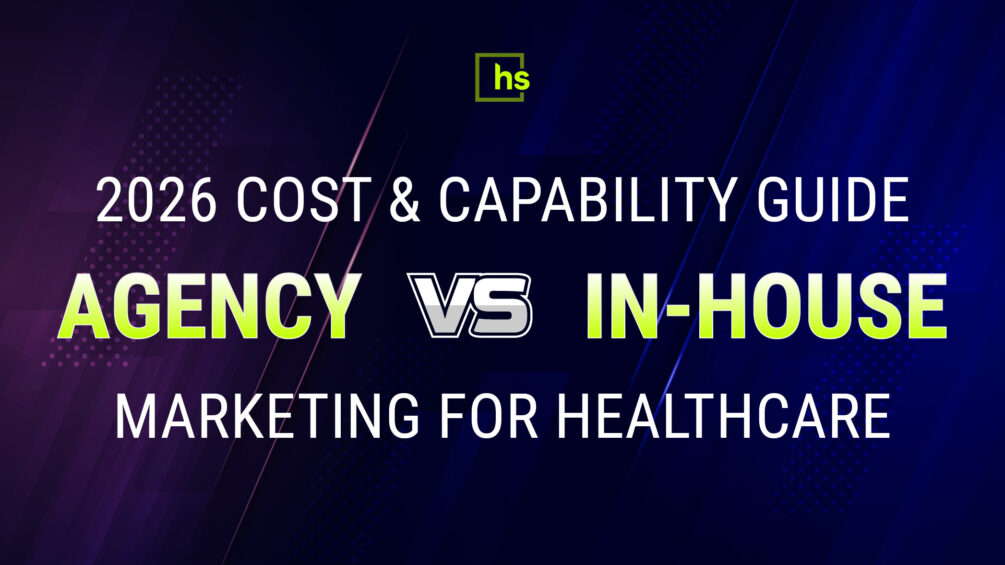
Agency vs In-House Marketing for Healthcare: 2026 Cost & Capability Guide
Originally published May 2018
Last updated January 2026
Over the years, I’ve worked with hospitals, health systems, multi-location medical groups, telehealth organizations and healthcare technology companies across the country. One question comes up consistently—often early in the relationship and sometimes after a few false starts:
Should we build our marketing team in-house, or should we hire a healthcare marketing agency?
It’s a fair question. Marketing is a significant investment, and healthcare leaders want to make smart, defensible decisions. What I’ve seen repeatedly, however, is that this question is usually framed the wrong way. For most growth-oriented healthcare organizations, the real answer isn’t agency or in-house. It’s how to structure a hybrid model that combines internal leadership with specialized agency expertise.
This guide walks through how I recommend healthcare organizations think about that decision—based on cost, capability, speed and long-term sustainability.
Medical Marketing Agencies vs. In-House Teams: The Right Questions to Ask
Before comparing models, it’s important to step back and look at what modern healthcare marketing actually requires. The complexity has increased dramatically—across digital channels, data, compliance, competition and patient expectations. That reality should drive how you staff and partner.
1. Are Your Long-Term Goals Clearly Defined?
Every effective marketing program starts with clear business goals. Are you expanding into new markets? Growing specific service lines? Supporting value-based care initiatives? Increasing patient access? Driving B2B demand for a healthcare technology platform?
Internal teams play an essential role here. They understand leadership priorities, internal dynamics and operational constraints. Where organizations often struggle is execution—turning strategy into coordinated, multi-channel programs that actually perform.
That’s where agencies add value. Once goals are defined, a specialized healthcare marketing agency can help determine the fastest, most efficient path to achieving them—without forcing your internal team to reinvent systems or learn everything from scratch.
2. Do You Have Marketing Staff In-House—and What Can They Realistically Handle?
I’m a strong believer in having internal marketing leadership. In-house marketers bring institutional knowledge, understand compliance and approvals and serve as the connective tissue between executives, clinicians and external partners.
That said, it is unrealistic for you to expect a single internal hire—or even a small internal team—to successfully cover the full scope of modern healthcare marketing at a high level. Today’s environment demands specialists in:
- SEO and technical optimization
- Paid search and paid social
- Content strategy and production
- UX and conversion optimization
- Analytics and reporting
- Website performance and development
Just as no physician practices every specialty, no marketer can do all of this well. Expecting them to try usually leads to burnout, missed opportunities and inconsistent results.
Think of a marketing agency as your “team of healthcare marketing specialists.”
This is why the most successful organizations pair internal leadership with comprehensive healthcare marketing services delivered by an agency built for this level of complexity.
3. Is In-House Marketing Actually Less Expensive?
Many healthcare leaders assume hiring internally will save money. In my experience, that’s possible but rarely true—especially at the enterprise level.
By the time you account for salaries, benefits, recruiting, turnover risk and ongoing training, costs add up quickly. Add in marketing technology—SEO tools, analytics platforms, creative software, automation systems—and the investment grows even further.
Agency retainers, by contrast, provide immediate access to senior strategy, specialized execution and enterprise-grade tools at a predictable cost. When organizations evaluate healthcare marketing agency cost realistically, agencies are often the more efficient option—especially when results and speed matter.
The key shift here is mindset: Marketing is not an expense to minimize, but an investment to structure wisely.
4. Does Working With an Agency Mean Losing Control?
This is another common concern—and one I think is based on outdated assumptions.
The right agency relationship doesn’t remove internal control; it enhances it. Strong agencies operate transparently, collaborate closely and partner with internal stakeholders to keep them informed through regular reporting and communication.
In fact, when internal teams are supported by an agency, they often gain more visibility and influence—because execution is handled consistently, data is clearer and leadership conversations become more strategic.
5. Have You Evaluated Healthcare-Specific Expertise?
Healthcare marketing is different. Compliance, brand trust, patient sensitivity and regulatory considerations all matter. Before making any decision, organizations should review questions to ask when evaluating agencies and ensure potential partners have real healthcare experience—not just general marketing credentials.
The Hybrid Model: Why This Is What I Recommend Most Often
After two decades in this space, I can say this clearly: For most healthcare organizations, a hybrid model is the most effective and sustainable approach.
How the Hybrid Marketing Model Works
In a hybrid structure, internal marketing leaders own strategy, priorities, approvals and institutional knowledge. They set direction and ensure alignment with business and clinical goals.
The agency provides execution depth, specialized expertise and scalable capacity—supporting SEO, paid media, analytics, creative production and major initiatives like service-line launches, rebrands or digital transformation.
When done correctly, the agency isn’t a vendor—it’s an extension of the internal team.
Benefits of the Hybrid Approach
Hybrid models offer flexibility and scalability that purely internal teams can’t match. Agencies can scale up quickly when priorities shift and scale back without the disruption of hiring or layoffs.
They also reduce risk. Internal teams stay focused on leadership alignment and strategic oversight, while agencies bring proven processes, cross-industry insight and continuous optimization. Over time, I often see internal teams become stronger through collaboration and knowledge sharing.
Most importantly, hybrid models produce better outcomes—fewer bottlenecks, faster execution and more resilient marketing programs.
When Hybrid Makes the Most Sense in Healthcare
Hybrid models are especially effective for hospitals, health systems, multi-location practices, behavioral health organizations, telehealth platforms and healthcare SaaS companies.
These organizations need control and speed. They operate in changing markets with shifting priorities, and they can’t afford to staff every specialty internally. Hybrid partnerships provide the balance needed to grow responsibly and sustainably.
Cost Comparison Example: In-House vs. Agency vs. Hybrid
| Cost Factor | Small In-House Team | Agency Only | Hybrid Model |
|---|---|---|---|
| Annual Cost | $200K–$400K+ | $120K+ | $200K +/- |
| What’s Included | Salaries, benefits, tools | Full specialist team | 1 FTE + agency |
| Flexibility | Low | High | Medium–High |
| Expertise Depth | Limited | Extensive | Best of both |
| Time to Results | Slow | Immediate | Fast |
When an Agency Makes More Sense Than Hiring In-House
For most healthcare organizations, building a fully capable internal team is slow, expensive and difficult to maintain. Agencies provide immediate access to senior strategy and specialized execution—without long ramp times or ongoing overhead.
This is especially true when multiple channels must work together toward shared performance goals.
What Agencies Handle vs. Internal Teams
In the most successful partnerships, I see:
- Internal teams focus on vision, priorities, approvals and subject-matter expertise
- Agencies handle strategy development, execution, optimization, reporting and daily channel management
This structure allows organizations to move faster while maintaining control and accountability.
Final Takeaway
For most businesses, healthcare marketing today is too complex to keep entirely in-house. The organizations that perform best invest in strong internal leadership—supported by a specialized healthcare marketing agency that brings depth, speed, and experience.
If you’re evaluating options, I recommend starting with our healthcare marketing agency guide or by reviewing how to choose the right healthcare marketing agency to ensure the right fit.
Related Articles:
Podcast: Why You Should Choose a Marketing Agency That Specializes in Healthcare
Choosing a Healthcare Marketing Agency: Our 11-Point Checklist of Critical Considerations
Red Flags to Avoid When Searching for a Healthcare Marketing Agency
What Some Healthcare Marketing Agencies Won’t Tell You
3 Critical Questions to Ask Yourself Before You Hire a Healthcare Advertising Agency
Healthcare Advertising Agency: What to Look For Before You Hire