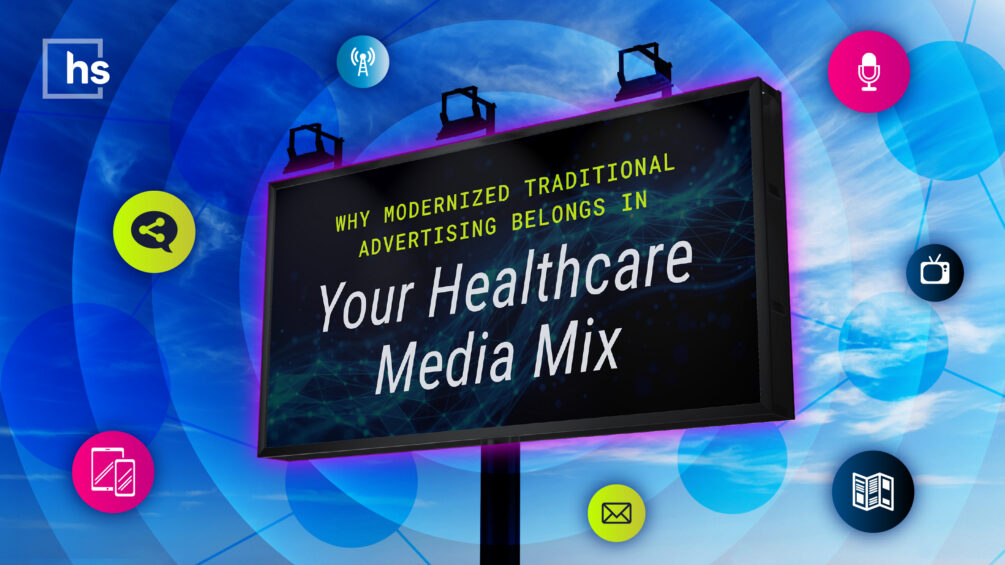
Why Modernized Traditional Advertising Belongs in Your Healthcare Media Mix
Advertising executives love a good debate. For years the industry has pitted “traditional” channels—television, radio, billboards, direct mail—against digital platforms like search, social and programmatic display.
But in healthcare, that debate misses the point. Traditional media isn’t dead—it’s just been waiting for you to modernize it. The real question isn’t whether to buy TV or PPC. It’s how to make all your channels work together to reflect how patients actually make decisions.
Modern healthcare consumers don’t follow a neat funnel. They see a billboard on the drive home, ask Siri for “hip surgeons near me,” scroll past a YouTube ad, hear a podcast endorsement, read physician reviews and then—maybe weeks later—book an appointment. They move back and forth between brand impressions and direct‑response prompts until they feel confident enough to act.
This article shows why modernized traditional advertising belongs in that messy mix and how to use it to create demand, amplify your digital efforts and build a stronger brand.
The Fragmented Media Landscape—An Opportunity, Not a Crisis
If you feel overwhelmed by the number of channels vying for your budget, you’re not alone. Healthcare audiences stream shows, listen to podcasts, watch connected TV (CTV), still flip through radio dial during commutes and drive past billboards every day. They receive postcards at home, browse social feeds, read Google reviews and sometimes ask ChatGPT or Siri for recommendations.
Fragmentation is the new norm
The old media model—buying a handful of TV spots and newspaper ads—no longer reflects reality. The U.S. now has hundreds of TV networks, dozens of streaming services, thousands of podcasts and millions of websites. In healthcare, this fragmentation can feel daunting because audiences often span multiple generations and geographies.
- Younger patients (18‑30) rarely watch live TV or listen to terrestrial radio. They stream shows on Hulu, Netflix or YouTube and follow influencers on TikTok.
- Middle‑aged patients (35‑55) split their time between broadcast television and streaming platforms. They may still flip on the local news or cable but have embraced CTV and on‑demand radio as well.
- Older patients (55+) still consume traditional TV and radio for news and sports, while slowly adopting streaming options. They are more likely to notice direct mail and local newspaper inserts.
Despite these shifts, one thing hasn’t changed: everyone still drives past billboards. Out‑of‑home advertising remains the most consistent touchpoint across age groups because nearly everyone—whether they’re 22 or 72—spends time in a vehicle. That’s why billboards remain an essential brand‑building channel, particularly when combined with digital targeting (as we’ll explain later).
The messy journey is your opportunity
Consumers don’t choose a doctor after seeing one ad. They gather impressions, opinions and evidence over time. That complexity is an opportunity if you plan properly. By showing up in multiple places with a coherent message, you reinforce your value and stay top‑of‑mind when patients are ready to act.
Why “Traditional vs. Digital” Is the Wrong Debate
Many organizations treat media planning like a zero‑sum game: every dollar that goes to television is a dollar taken away from search. But focusing on this tug‑of‑war misses how advertising really works.
Demand creation vs. demand capture
Many digital tactics—search, SEO, AEO/GEO, and local SEO—capture demand. They connect with people actively searching for “orthopedic surgeons near me” or “Medicare Advantage plans.” They’re great at harvesting intent.
Traditional channels—TV, radio, billboards, direct mail—create demand. Like paid social media and programmatic advertising, these channels can introduce you to people who didn’t know your service existed, shape perceptions, and keep your brand top‑of‑mind until they or someone they love needs you.
To grow, you need to create demand and capture it. That means modernizing traditional advertising to work in tandem with your digital tactics.
Evidence that integrated campaigns work
Over the past four decades, our media lead Charlie DeNatale has planned and negotiated campaigns in more than 200 U.S. markets. He doesn’t just buy spots—he watches for the tell‑tale data spikes that prove when channels are working together. A few recent examples:
- Radio + Billboards → Search: A behavioral health organization combined live radio endorsements with a billboard blitz. Within minutes after each radio flight, their website analytics lit up: a surge in branded search queries and new visitors. When they paused radio, the spikes disappeared. The lesson: radio created demand that digital could capture.
- Billboards + Geofencing: An orthopedic practice modernized its billboards by adding geofencing. Whenever someone in the target demographic drove past a board, they were later served a mobile display ad while using any one of 100,000 apps such as CNN, The Weather Channel or ESPN. Dozens of click‑throughs turned into measurable new users on the website—proof that the analogue and digital touches were working together.
- TV + PPC: A multi‑location surgery center saw its paid search performance slip. Rather than cut budget, they added a TV flight on the local ABC affiliate and a series of targeted radio spots. Branded search queries jumped almost immediately and the quality of leads improved. The TV didn’t cannibalize search; it amplified it.
- Brand Awareness + Digital Follow‑Up: When a behavioral‑health company rebranded, they invested in a year‑long billboard and radio program across Minneapolis and other markets. Monthly geofencing reports showed how many impressions were served, how many digital ads were delivered, and how many people clicked through. The click‑through numbers lined up almost perfectly with new‑user data in their web analytics, showing that the offline and online pieces were reinforcing each other.
Charlie’s takeaway: when you line up touchpoints intentionally—traditional and digital—you don’t just add impressions. You multiply them.
Modernizing Traditional Media
Billboards + Geofencing
Digital and static billboards still deliver unparalleled reach. They’re the one medium everyone sees, from commuters to parents running errands. Modern outdoor campaigns can include:
- Mobile geofencing: Place a virtual fence around each billboard.
- Audience profiling: Work with out‑of‑home vendors to identify billboards that deliver the highest concentration of your desired demographic—e.g., adults 50+ with household incomes above $100,000.
- Creative that drives action: Use simple messages—“Hip pain shouldn’t be your normal” or “Need a primary care doctor?”—plus your web address. QR codes and texting can work on some boards but usually limit readability; use them sparingly.
Recently, Charlie managed two separate billboard campaigns, the teams set a one‑ to two‑mile geofence around each board. Within those fences, they targeted suburban residents aged 25‑54 with household incomes above $100,000. People who fit those profiles and passed the board were served display ads across more than 100,000 mobile apps. Reports showed how many impressions and clicks the geofenced ads generated and, crucially, how many new users visited the website during the campaign. The same month a billboard generated 55 clicks, Google Analytics reported 54 new users on the site—an almost one‑to‑one relationship. That’s the power of modernized outdoor advertising.
Television, CTV & Branded Search
Television remains one of the fastest ways to reach a broad audience. It’s also one of the quickest ways to see how traditional drives digital. When a TV spot airs, savvy healthcare advertisers watch their analytics. Within minutes, branded search and web traffic rise. When the spot stops running, the lift disappears.
Key strategies:
- Pair TV with paid search: Reserve a portion of your media budget for paid search to catch the spike in interest after each TV flight. If someone sees your orthopedic or cancer center spot, they’re more likely to type your brand into Google than remember a phone number.
- Connected TV for targeting: Use CTV advertising to reach younger viewers with cable packages or streaming services. CTV offers addressable targeting similar to digital while retaining the impact of video.
- Track search spikes: Give your media vendor or agency read‑only access to website analytics. They can correlate media flighting with search patterns and site visits. This data will tell you what flights or creative are truly driving engagement.
During one campaign, Charlie negotiated with local stations to secure premium spots during morning and evening news. After each flight, the team checked website analytics and search reports. TV spots running at 10:55 AM on Tuesday drove 15 incremental web sessions within eight minutes; when the spots didn’t run, there was no spike. That data justified continuing the investment and informed better day‑parting the following quarter.
Radio & Streaming Audio
Radio isn’t dead; it’s different. Today, terrestrial radio excels at talk and news formats, which skew older and more affluent. Streaming audio—Spotify, Pandora, iHeartRadio—reaches younger, on‑the‑go listeners.
Modern radio strategies include:
- Live reads and endorsements: Talk‑show hosts or local influencers endorsing your health system or clinic can drive call volume and web visits. These reads feel more authentic than pre‑recorded spots.
- Pair radio with geofencing: Target digital audio ads to people who live near your clinics or pass your billboards.
- Measure calls and spikes: Use call tracking numbers and digital analytics to see immediate response. Many stations now provide minute‑by‑minute reporting on website traffic after your spots air.
Charlie’s campaigns for a fibroid clinic used live endorsements on urban talk radio stations to reach African‑American women. Within minutes of each endorsement, the clinic’s call center received inbound calls and Google Analytics recorded web sessions from mobile devices. The endorsements also drove uplift for Facebook and search campaigns, proving how old and new channels complement each other.
Direct Mail & Personalization
Don’t dismiss mail because you’re digital. Direct mail remains one of the best ways to reach seniors, Medicare‑eligible patients and geographically targeted audiences. A well‑timed postcard or letter—coordinated with digital remarketing and call center follow‑up—can deliver dramatic results.
- Use mail for high‑value service lines: Joint replacement seminars, cancer screening promotions and Medicare Advantage enrollment packets all benefit from mailings that patients can hold in their hands and show to family members.
- Personalize when possible: Variable data printing allows you to include the patient’s name, location, plan options and even their primary physician in the creative.
- Integrate with digital touchpoints: Include QR codes, personalized URLs or short vanity URLs that direct recipients to landing pages for registration or more information. Then remarket to those visitors via search and social ads.
Print & Niche Publications
Print isn’t a blanket recommendation anymore, but it still matters in niche contexts—such as clinical journals for physicians or regional magazines for affluent communities. If your goal is to recruit specialists, announce a new facility or increase donations, carefully selected print placements can deliver credibility and attention. The key is to integrate them into your broader mix with digital tracking URLs and follow‑up campaigns.
Building an Integrated Healthcare Advertising Strategy
Because the healthcare journey is messy, media planning must be disciplined. You can’t just sprinkle in a radio buy here or a billboard there and hope for synergy. You need a framework.
Start with business objectives
Ask: What exactly are we trying to achieve? Is it raising awareness of a new spine center? Increasing bariatric surgery cases? Boosting Medicare enrollments in open season? Recruiting more nurses? Different goals demand different channel mixes.
Know your audience and geography
Define demographics (age, income, ethnicity), psychographics (lifestyle, interests) and geography (city, suburbs, region). For example, a Medicare Advantage campaign for seniors in rural Iowa will look different from an urgent care campaign in suburban Chicago. Over‑targeting on multiple attributes, however, can make your audience too small to reach effectively.
Allocate budget between creation and capture
Charlie typically sees 65% to 70% of a budget invested in digital and 30% to 35% in traditional—but that ratio shifts based on objectives and audience.
Develop consistent creative with clear calls‑to‑action
Traditional and digital creative must work together. Your billboard should plant a memorable idea (“Go from pain to play”) while your search ad offers a clear next step (“Schedule your free hip replacement consult today”). Your radio endorsement should mention an easy‑to‑remember website; your CTV spot should show real physicians or patients, not stock footage.
Measure, learn and optimize
Attribution in healthcare is complicated. Many people see multiple ads before making decisions, and HIPAA restricts patient‑level tracking. But you can still measure:
- Brand search lift during media flights compared to baseline periods.
- Website session spikes within minutes of TV or radio runs.
- Mobile ad impressions and clicks within geofenced billboards.
- Call volume and call conversions using call tracking numbers.
- Appointment conversions measured in your CRM or scheduling system.
By correlating these data points with media schedules, you see which channels and creative drive results and where to reinvest.
Pitfalls to Avoid
We’ve seen integrated campaigns succeed spectacularly—and we’ve seen good ideas flop. Avoid these common pitfalls:
1. Siloed planning and execution
Digital and traditional teams often work in parallel universes.
Solution: Align your media teams and agencies. Start planning sessions with both groups in the room. Use shared performance dashboards so everyone sees the entire funnel.
2. Judging every channel on cost per lead
Traditional media rarely produces the same immediate cost per lead as search or social because it’s primarily creating demand. If you judge a billboard’s performance by cost per lead alone, you’ll cut it prematurely and lose the brand lift it provides.
Solution: Evaluate traditional channels on reach, frequency, search lift and brand perception. Use cost per lead for capture channels and cost per incremental new user for creation channels.
3. Treating traditional as an afterthought
Modern media planning requires you to consider how each touchpoint plays into the journey from the start.
Solution: Build your media mix holistically. Ask how each channel complements the others and sequence them intentionally—billboards and TV to create awareness, radio and CTV to nurture, search and call centers to capture.
Why Modernized Traditional Advertising Belongs in Your Mix
The real advantage of modernized traditional advertising isn't that it replaces digital marketing. It's that it makes every other part of your marketing work harder.
Healthcare marketers often optimize individual tactics—lowering paid search costs, improving SEO, refining social campaigns—but patients don't experience marketing one channel at a time. They experience a series of impressions that build familiarity, credibility and confidence long before they schedule an appointment.
That's why the most effective healthcare organizations don't think in terms of traditional versus digital. They think in terms of influence. Every channel has a different role to play. Some create awareness. Others reinforce credibility. Others capture intent when patients are finally ready to act.
When those touchpoints are planned together, the result is greater than the sum of the individual channels. Television lifts branded search. Billboards reinforce digital campaigns. Radio increases recall. Direct mail extends conversations already happening online. Each interaction makes the next one more effective.
Perhaps most importantly, modern traditional media is no longer the "unmeasurable" investment it once was. Search lift, geofencing, website analytics, call tracking and CRM reporting now make it possible to understand how offline media contributes to online behavior and business outcomes. The question is no longer whether traditional advertising works—it's whether you're measuring it correctly.
For healthcare organizations looking to grow in increasingly competitive markets, that's the opportunity. Modernize traditional media, integrate it with your digital strategy and evaluate success based on how the entire system performs—not how any single channel performs in isolation.
Conclusion: Modernize, Don’t Minimize
Healthcare advertising has become more complex—but also more measurable. Patients don't separate "traditional" from "digital," and neither should your marketing strategy. The organizations that outperform their competitors are the ones that build coordinated campaigns that create demand, reinforce trust and capture intent wherever patients choose to engage.
Modernized traditional advertising isn't about returning to yesterday's media plan. It's about using today's data, targeting and measurement to make proven channels work alongside digital in smarter, more accountable ways.
If your media mix hasn't evolved in years—or your digital performance has begun to plateau—it may be time to stop asking which channels deserve your budget and start asking how they can work together to produce better results.
FAQs
Q: When should a digital-first healthcare organization add traditional media?
When you need more brand awareness or top-of-funnel demand, serve older or caregiver-heavy audiences, or are rebranding or entering new markets.
Q:How much budget should go to traditional media vs. digital?
Often 60% to 70% digital and 30% to 40% traditional, but the exact mix depends on your audience, service lines, markets and current results.
Q:What are examples of modernized traditional advertising in healthcare?
Billboards with mobile geofencing, TV and CTV measured via branded search lift, radio endorsements supported by digital, and mail integrated with landing pages and remarketing.
Q: Can traditional advertising still work if we focus on younger patients?
Yes, as part of a mix—billboards, CTV and streaming audio can reach younger adults, but they must be coordinated with strong digital campaigns.
Subscribe for More:
Don’t miss future insights—subscribe to our blog and join us on LinkedIn: Stewart Gandolf and Healthcare Success.