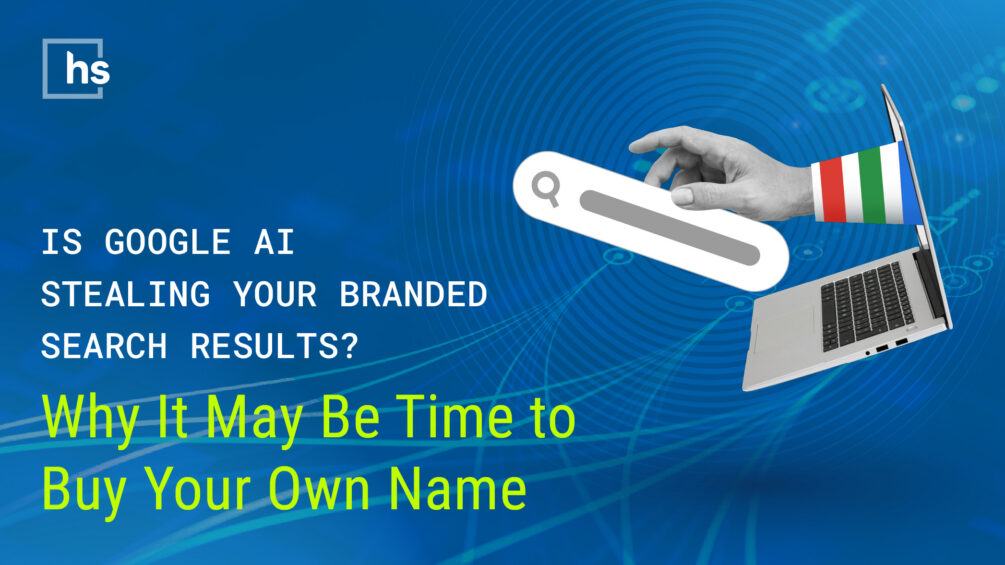
Is Google AI Stealing Your Branded Search Results? Why It May Be Time to Buy Your Own Name
For years, many sophisticated marketers have questioned the value of bidding on their own brand name in paid search.
Why pay Google for a click you could get organically for free? If someone searches specifically for your organization, and your website already ranks first, buying that same traffic can feel redundant.
But AI Overviews and increasingly crowded search results are changing that calculation.
Today, even people who search for your organization by name may not see your website first—or even clearly understand which search result is actually you.
We recently saw a dramatic example with one of our clients.
When Google Gets Your Brand Wrong
Our client is an addiction treatment organization in the Memphis market. Unfortunately, its name is similar to those of several unrelated businesses around the country.
Historically, that wasn’t an insurmountable SEO problem. Google had enough geographic and contextual information to determine what someone searching locally probably wanted.
Then the search results changed.
A branded Google search began producing an AI-dominated results page filled with information about similarly named organizations, including a long-term care center in Texas and a restaurant in Georgia. Our client’s website was still there, but it was increasingly lost in the haze.
The problem extended beyond traditional organic rankings. Google’s interpretation of the brand also affected the overall local search experience, including the visibility and clarity of the organization’s Google Business Profile.
Think about what that means from the prospective patient’s perspective. Someone hears about the treatment center from a physician, therapist, family member, alumnus, advertisement, or another referral source. They Google the organization’s name.
That’s about as high-intent a search as you can get.
And instead of immediately finding the organization they’re looking for, they’re confronted with AI-generated content and similarly named businesses hundreds or thousands of miles away. At exactly the moment when Google should be confirming the patient’s choice, Google is creating confusion.
We Can Fight Back Organically. But Organic SEO Takes Time.
There are numerous organic strategies marketers can use to help Google better understand a brand and distinguish it from similarly named organizations. In this case, we did exactly that.
We worked on the signals Google uses to understand the organization: its identity, location, services, website, local presence, and broader entity relationships.
Those efforts matter. In the AI search era, organizations need to think beyond traditional rankings and help search engines and AI systems understand who they are, what they do, where they operate, and why they are authoritative.
But there’s a frustrating reality about organic search: you can do everything right and still have to wait.
Google decides when to crawl something, when to incorporate those signals, what appears in an AI Overview, and ultimately how the search results page is assembled.
Our client had a problem happening right now. Fortunately, there was another option.
The Fastest Solution Was Also the Simplest: Buy the Brand Name
We could bid on the client’s own name with Google Ads.
Instead of hoping Google would correctly interpret the searcher’s intent, we could put the actual organization at or near the top of the search results. The ad could clearly identify the correct organization, service, location, and website.
For a Denver consumer looking for addiction treatment, there was no longer any question about whether the result referred to a nursing facility in Texas, a restaurant in Georgia, or the organization they were actually trying to find.
And unlike organic SEO, which can take weeks or months to influence search results, paid search can provide visibility almost immediately.
That’s what makes branded PPC increasingly interesting in the age of AI search.
Branded PPC Isn’t Just About Traffic Anymore
Traditionally, branded PPC was evaluated largely as a traffic-acquisition tactic. That led to a reasonable debate: If someone searches for your brand, wouldn’t they have found you organically anyway? And if so, are you simply paying Google for traffic you already earned through your reputation, advertising, referrals, and other marketing?
Sometimes, yes.
That’s why we have never been fans of using spectacular branded-search ROAS numbers to prove that paid search is generating new demand. Brand and non-brand paid search should be evaluated separately.
But that debate misses an increasingly important reason to advertise on your own name.
Branded PPC can now be a brand-protection strategy.
The goal isn’t necessarily to generate a click that wouldn’t otherwise have happened. The goal can simply be to make sure someone who is already looking for you actually finds you.
AI Overviews, featured content, local results, review sites, competitors, and other SERP features can now occupy enormous amounts of screen real estate. Your #1 organic ranking may technically still be #1, but that doesn’t necessarily mean you’re the first—or most prominent—thing the searcher sees.
AI Has Changed What It Means to “Rank #1”
For decades, healthcare marketers have talked about rankings as though Google were a list.
You’re number one. You’re number two. You’re number three.
Today’s Google results increasingly aren’t a list. They’re an experience.
Depending on the search, that experience can include ads, AI Overviews, maps, Google Business Profiles, videos, review sites, featured snippets, People Also Ask results, and conventional organic listings.
So the question healthcare marketers should be asking is no longer simply:
“Where does our website rank?”
It’s:
“What does someone actually see when they Google our name?”
Those can be very different things.
Google Your Own Organization. Then Look at the Page Like a Consumer.
This is an exercise every healthcare marketer should perform periodically.
Search your organization’s name. Search common variations. Search from the markets you serve. Search your brand plus your specialty, location, and other terms consumers might use.
Then forget everything you know about your company and look at the results through the eyes of a prospective patient.
Ask yourself:
- Is it immediately obvious which result is us?
- Does Google accurately describe what we do?
- Does an AI Overview dominate the page?
- Are competitors appearing?
- Are similarly named organizations creating confusion?
- Is our Google Business Profile prominent and accurate?
- How far does someone actually have to scroll before reaching something we control?
For many established healthcare brands, the answers will still be reassuring. For others, they may be surprising.
Should You Start Bidding on Your Own Brand?
Not necessarily.
If you completely dominate branded searches organically, Google clearly understands your organization, competitors aren’t causing problems, and your website and local presence occupy the SERP, there may be little reason to dramatically increase branded paid-search spending.
But the old assumption that “we rank first organically, so we don’t need to buy our name” deserves another look, especially if:
- AI Overviews are pushing your organic results down the page.
- Your organization’s name is generic or shared with other businesses.
- Google appears confused about your brand or location.
- Competitors are bidding on your name.
- Review and directory sites dominate branded searches.
- Your Google Business Profile isn’t consistently prominent.
- A branded search doesn’t immediately make it obvious who you are.
In those situations, branded paid search can be remarkably inexpensive insurance.
And for healthcare organizations, the economics can be especially compelling. A prospective patient who already knows your name isn’t casually browsing. They may have received a referral, seen an advertisement, talked to a friend, or already decided to contact you.
Losing that person because Google’s increasingly complicated results page created confusion is an expensive mistake. Paying a few dollars to prevent it can be a very good trade.
In AI Search, Sometimes the Best SEO Strategy Is PPC
We still believe strongly in doing the organic work. Healthcare organizations need authoritative websites, strong local SEO, accurate structured information, consistent brand signals, and content that helps both consumers and AI systems understand who they are.
But marketers also need to recognize when they’re dealing with a long-term problem that has an immediate solution.
Our Denver client’s branded search problem required substantial organic work to help Google better distinguish the organization from similarly named businesses. We did that work, and it remains important.
But while those efforts take hold, paid search gives us something increasingly scarce in today’s search environment: a fast, controllable way to get the right message near or at the top of the page.
That’s why the rise of AI Overviews may ultimately change one of paid search’s oldest debates.
Buying your own name isn’t necessarily paying for a click you would have gotten anyway.
Sometimes, it’s paying to make sure Google doesn’t lose your customer on the way to your front door.eaming audio can reach younger adults, but they must be coordinated with strong digital campaigns.
Subscribe for More:
Don’t miss future insights—subscribe to our blog and join us on LinkedIn: Stewart Gandolf and Healthcare Success.