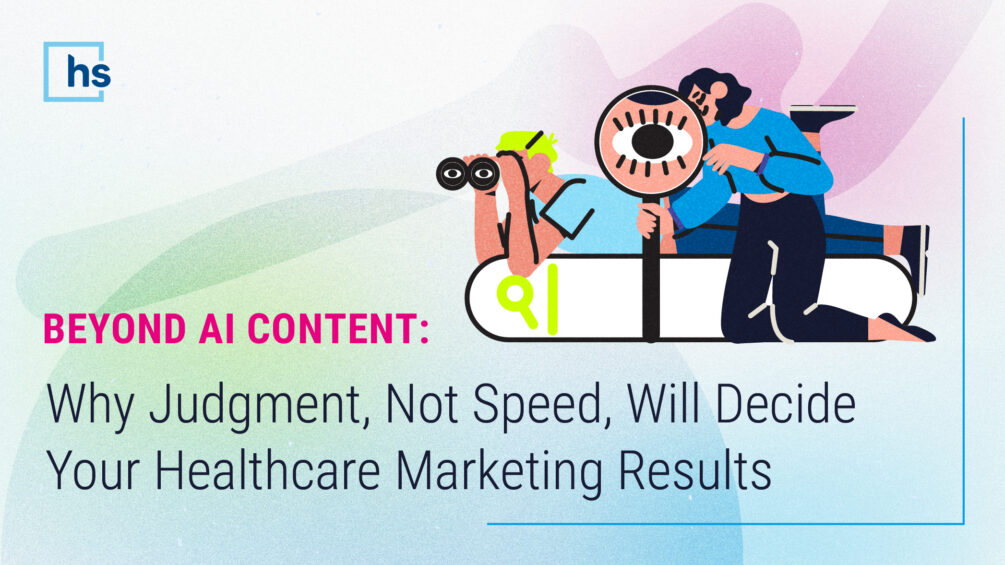
Beyond AI Content: Why Judgment, Not Speed, Will Decide Your Healthcare Marketing Results
In February 2020, everyone had heard of COVID, but almost no one understood how completely it would reshape life and business. Looking back, I often divide time into pre‑COVID and post‑COVID: lives were lost, cultures changed, operating models shifted, and expectations were rewritten.
Today, a growing number of technology and marketing leaders are making a similar comparison about AI. Matt Shumer, CEO of HyperWrite, recently described this as “February 2020 for AI”—the moment when the signals are visible, but most people haven’t yet connected the dots.
In healthcare, that comparison feels especially apt, because AI is already collapsing execution timelines while our complexity, regulation, and trust requirements remain as high as ever. And many knowledge workers still underestimate how much their professional lives are going to change—sometimes for the better, and sometimes for the worse.
AI Has Collapsed Timelines—Not Healthcare Complexity
Recently, at our vacation home in Palm Springs, I looked at the front yard and thought, “I should call a landscape designer.”
Instead, I opened an AI tool.
Over a few hours, I walked it through the home’s mid‑century modern aesthetic, shared photos of the current layout, listed the plants I like, and described how I wanted the lighting to feel at night. AI helped me visualize options, refine ideas, and land on a plan I’m genuinely excited about.
No designer was “replaced.”
I just didn’t need one for that specific problem anymore.
Your patients, referring physicians, and customers are discovering their own versions of this every day. AI is compressing the distance between “I have an idea” and “I have something usable in my hands.”
In marketing, that now looks like:
- Drafting landing pages, emails, and ads in an afternoon.
- Summarizing dense decks, research, and clinical content into usable insights.
- Generating multiple creative or messaging variations for testing.
But while execution is faster and cheaper, healthcare itself has not become simpler:
- Multiple stakeholder audiences (patients, physicians, payers, boards)
- Regulatory and compliance oversight
- Complex service lines and referral patterns
- High‑stakes decisions that affect care, trust, and revenue
AI can accelerate work. It cannot, by itself, resolve the fundamental complexity of healthcare marketing.
Read next: 2026 Healthcare Marketing Predictions: What Leaders Must Prepare for Now
The New Risk: “AI‑Flavored” Marketing That Erodes Trust
We’re hearing a consistent refrain from executives who come to Healthcare Success from other agencies:
“We left in part because our content started looking like it came from AI.”
When we unpack that, they usually mean:
- Their voice became generic.
- Details were inconsistent or shallow.
- The content technically “said the right things” but didn’t sound like them or missed clinical nuance.
AI has introduced a new kind of mediocrity: work that is fast and polished on the surface, but hollow underneath.
In healthcare, that’s not a cosmetic issue. It’s a trust issue.
- Patients notice when communications feel robotic or interchangeable.
- Physicians quickly tune out messaging that doesn’t reflect their reality or language.
- Compliance risk increases when AI‑generated copy isn’t rigorously reviewed and contextualized.
The answer is not to ban AI.
The answer is to pair AI with strong human filters and domain expertise.
Why Judgment, Not Speed, Drives Healthcare Marketing Results
As AI drives execution time toward zero, the value in healthcare marketing doesn’t disappear; it moves.
The new scarcity is judgment:
- Which growth problems are worth solving in the first place?
- What should you ask AI to do—and what should remain human‑only?
- How do you protect clinical accuracy, brand integrity, and regulatory compliance while moving faster?
- How do you turn a stack of AI‑assisted drafts into a cohesive strategy that actually drives patient volume, case mix, or referrals?
In this environment, the critical asset is no longer keystrokes. It’s taste, discernment, and deep situational awareness.
This is why generalist, execution‑only, and pure “content volume” models are under pressure. When an agency’s main promise is “we produce lots of blog posts and social content,” they are now competing directly with tools that can generate acceptable first drafts in seconds.
By contrast, specialized healthcare agencies are solving a different class of problems:
- Designing strategies across complex patient journeys
- Influencing referral patterns across specialties and sites of care
- Integrating online and offline channels in regulated environments
- Helping health systems and PE‑backed platforms hit aggressive growth and margin targets
- Generating content that wins the favor of both Google and the AI engines
AI doesn’t make that complexity go away. It raises the bar for how fast and how intelligently those problems must be addressed.
How We Use AI at Healthcare Success (And How We Don’t)
For our agency, AI is not a thought experiment—it is changing how we operate right now.
Over more than 20 years, Healthcare Success has navigated the Great Recession, COVID, the Great Resignation, and multiple digital shifts. Each wave took out solid agencies that either couldn’t or didn’t adapt.
This wave feels different because AI is simultaneously:
- Accelerating what clients rightly expect from us in terms of speed and throughput.
- Driving down the perceived value of basic production work.
- Flooding the talent market with people whose firms weren’t able to transition.
Our response has been deliberate:
- We’ve doubled down on healthcare. We are not trying to be a generalist shop; our focus is healthcare providers, systems, and health‑related organizations.
- We use AI as a force multiplier, not a substitute. We leverage AI to digest massive enterprise content sets and build internal knowledge bases, not to spin out generic content.
- We’ve built workflows and governance. AI‑assisted work still passes serious human review—strategic, editorial, and when needed clinical—before it ever reaches physicians, patients, or investors.
And just as importantly:
We are not using AI as a shortcut to quietly pad margins.
We’re using it to do more for our clients with the same budget.
In practical terms, that means we can finally tackle important but historically “rote” work—like structuring data, building out schema, iterating more test variants, or synthesizing dense clinical content—far faster than before.
The client investment stays the same.
The amount of real work completed and ground covered increases dramatically.
That doesn’t make us immune to change. But it does keep us playing the right game: owning judgment, not just output—and reinvesting AI‑driven efficiency back into client value.
What Healthcare Leaders Should Expect From Their Agencies in the AI Era
If you’re leading a health system, physician platform, or medical device company, AI should influence how you evaluate and manage marketing partners.
Key questions to ask:
- How do you integrate AI into your workflows today?
Ask for specifics. Where does AI accelerate research, drafting, analysis, or optimization? Where is human review mandatory? - How do you protect clinical accuracy and regulatory compliance when using AI?
Look for defined processes: medical editing, subject‑matter expert review, and clear approval paths. - What healthcare‑specific expertise do you bring that my internal team doesn’t have?
Seek depth: service‑line experience, understanding of referral dynamics, familiarity with system politics and constraints. - How will AI change the speed, cost, and quality of our work together over the next 12 to 24 months?
The best partners talk about doing more with a given budget, not quietly doing less and calling it “efficiency.” - How do you measure success?
Insist on metrics tied to real business outcomes—patient volume, revenue, case mix, referrals—not just content volume or vanity engagement.
Agencies that can answer these questions concretely are much more likely to navigate the AI transition in a way that benefits you and your patients.
How to Use AI Inside Your Own Organization—Without Losing the Plot
On the client side, AI also presents real opportunities—if you deploy it thoughtfully.
A few practical moves we’re seeing work well:
- Use AI to accelerate internal work, not to replace strategy.
Have your teams use AI for summarizing long documents, drafting internal briefs, or exploring early‑stage ideas so they can spend more time on decisions and collaboration. - Use AI (and AI agents) to improve the patient journey and conversion.
Consider AI‑driven assistants on your website or call center that can answer common questions, route patients more efficiently, and reduce friction in scheduling. Done well, these agents can significantly improve the patient experience and lift conversion rates compared to traditional, purely manual workflows. - Keep human judgment where trust and risk are highest.
Anything that influences patient understanding, clinician decisions, or regulatory exposure should still go through strong human review. AI can help draft and organize; people must still decide what is safe, accurate, and on‑brand. - Upgrade measurement with AI‑enabled call tracking and attribution.
Work with your agency to implement call tracking and AI‑powered conversation intelligence so you can see which campaigns and touchpoints actually drive high‑value calls and appointments—and then optimize your media and messaging accordingly. - Consolidate stakeholder input into clear, AI‑assisted consensus briefs.
Use AI to help synthesize feedback from marketing, clinical, operations, and leadership into a single, coherent brief your agency can execute on. This reduces back‑and‑forth, keeps everyone aligned, and ensures your partners are working from one agreed‑upon source of truth. - Ask your agency how to “meet in the middle.”
Often the best results come when both your internal team and your agency use AI, with the agency providing the healthcare and marketing judgment to turn AI‑assisted drafts and insights into effective, compliant programs.
AI is here to stay. The organizations that thrive won’t be the ones who ignore it—or the ones who blindly outsource everything to it. They’ll be the ones who treat AI as an accelerant and double down on human judgment, domain expertise, and clear strategy.
Let’s talk about AI in your healthcare marketing.
Subscribe for More:
Don’t miss future insights—subscribe to our blog and join us on LinkedIn: Stewart Gandolf and Healthcare Success.