
How AI and PMax Are Disrupting Paid Search Attribution
If your paid search conversions have mysteriously dropped (or your dashboard looks too good to be true), you’re not alone.
AI is rewriting the rules of paid search. From shifting search engine results page (SERP) visibility to murky performance metrics, AI Overviews and Performance Max (PMax) campaigns are challenging how healthcare organizations measure success.
In the final part of our four-part series on how AI-powered search is rewiring healthcare marketing, we explore how AI is disrupting paid search attribution and what healthcare marketers can do about it.
Let’s go.
Setting the Stage for Smarter Measurement
Historically, paid media measurement has relied on last-click, keyword-level data. That model has rapidly eroded, thanks to disruptions from AI and Google’s PMax.
| What Is Performance Max (PMax)? Performance Max is Google’s AI-powered ad campaign type that automatically runs ads across Search, YouTube, Display, Gmail, and more. It uses machine learning to optimize your budget and targeting for better results—reducing manual effort but changing how you measure success. |
What’s more, paid search ads appear further down the SERP than ever before, resulting in reduced click volume and distorted conversion metrics.
But measurement isn’t broken, it’s evolving.
Healthcare marketers must pivot to new attribution tools (and mindsets!) as patient journeys become increasingly fragmented across channels and devices.
It’s time to enhance your healthcare paid ad measurement strategy with:
- Tracking outcomes beyond the click (e.g., appointment completions or revenue impact).
- Importing offline conversations into ad platforms to get a more accurate picture of paid search ROI.
- Using multi-touch attribution models to more accurately reflect complex patient journeys.
But before we go over solutions that actually work, let’s unpack how AI Overviews and PMax are impacting healthcare paid search reporting.
Rethinking Paid Search Metrics in the Age of AI and PMax
Impressions ≠ impact. Clicks ≠ conversions.
AI Overviews Are Pushing Ads Further Down
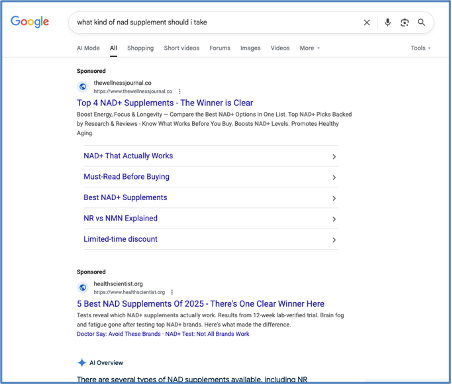
In many cases, paid ads are now pushed below AI Overviews in search results.
Google Ads has confirmed that paid ads can appear either above/below or within AI Overviews, but never in more than one of those positions at the same time.
That unpredictability makes consistent search ad visibility very difficult to achieve.
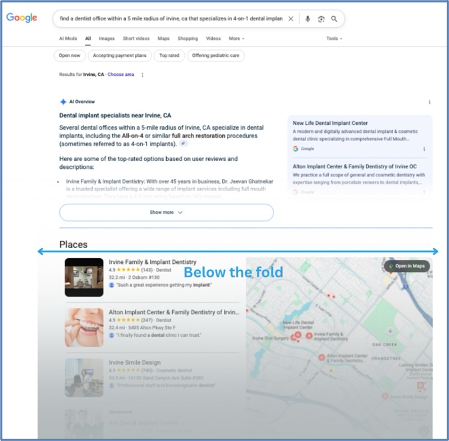
While Google has not publicly disclosed how to get your paid ads to appear above the fold, here’s what we know as of this writing:
- Use broad match search campaigns with smart bidding to align ads with AI-generated queries.
- Meet Google’s ad rank and relevance criteria by optimizing creative and targeting.
- Create high-quality landing content with strong E-E-A-T (experience, expertise, authoritativeness, and trustworthiness) signals.
Even when your ad does appear, Performance Max campaign reporting may not be accurate.
Why Your Reporting Dashboard May Be Misleading
It’s time to look beyond (like, in a galaxy far, far away, beyond) impressions, click-through rates, and even ROAS (return on ad spend). Why? These can be inflated or misattributed inside PMax.
It’s time to widen your lens and explore what PMax’s channel-level reporting tools can really tell you. To get a true read on performance, healthcare marketers must:
- Use channel breakout reports to compare how PMax allocates spend.
- Run incrementality tests to find out whether PMax is truly driving new conversions (or just retargeting past visitors).
- Integrate first-party data to validate reported performance against actual lead, prospect, and patient actions.
While PMax can be valuable for retargeting and bottom-funnel performance, it falls short when it comes to driving new patient acquisition or measuring true impact.
And that brings us to the core issue: the paid search attribution black box at the heart of Performance Max.
The PMax Attribution Black Box
Data transparency is improving, but core issues linger.
Here’s a quick breakdown that highlights where PMax excels and where it falls short:
| PMax Capabilities | PMax Limitations |
| Efficient at retargeting known patients to boost repeat visits.Automatically allocates budget to high-performing channels for better spend efficiency.Uses AI to optimize creative and messaging combinations.Supports bottom-funnel conversions, like appointment bookings and inquiries.Runs ads across Google’s broad ecosystem: Search, YouTube, Gmail, and more.Reduces manual campaign setup and ongoing management effort. | Limited effectiveness for acquiring new patients.Prioritizes low-funnel tactics, limiting growth from top-of-funnel efforts.Lacks transparency into search queries and user intent.Can inflate reported ROI by attributing conversions inaccurately.No detailed visibility into how individual Google channels perform.Difficult to connect spend directly to real patient actions and revenue. |
The key takeaway? Never over-rely on PMax to build your pipeline or measure marketing success.
Paid Search Attribution Strategies That Actually Work
Reclaim clarity and control.
Track Real Patient Actions, Not Just Clicks
Clicks are only a signal. The real data lies in what happens after. Here’s what to track:
- Appointment bookings.
- Phone call outcomes.
- Conversion events that align with revenue-driving services (not just form fills).
Use First-Party Data and Offline Conversions
Integrate backend data to get a clearer picture:
- Sync your CRM or EHR data with Google Ads.
- Use unique tracking numbers and URLs to connect online and offline interactions.
- Build custom audiences (based on real patient data) to improve targeting.
These tactics will help you target or retarget your ads more effectively, track real-world outcomes, and connect digital actions to in-person visits.
Don’t Rely on PMax Alone
PMax is a supporting character, not the star of the show.
Parse out certain campaigns to isolate performance metrics and maintain control over messaging and targeting.
- Run a manual search and display campaigns.
- Separate branded campaigns.
- Use independent analytics platforms to validate performance (e.g., GA4, Looker Studio).
- Use PMax strategically for branded retargeting and bottom-funnel campaigns, where its automation can shine and stretch your budget.
What Healthcare Marketing Leaders Need to Watch Next
Stay agile, informed, and ready to pivot.
Expect Continued SERP Evolution
- AI Overviews and zero-click searches will continue to change how patients search for and find healthcare services.
- Paid search may become even more blended with organic results, making visibility and attribution even more difficult to track.
- Voice search, personalized answers, and conversational AI will create even more PPC attribution problems.
Why a Blended Strategy Is Essential
Don’t spend your entire ad budget in one place. For best results, build a blended strategy:
- Diversify campaign types (e.g., search, display, video, and remarketing).
- Invest in owned channels (e.g., content and email) to reduce reliance on paid channels.
- Audit reporting dashboards often because automation can shift quickly and without notice.
Do not mistake AI Overviews and PMax for silver bullets, but essential pieces of a much broader, data-informed growth strategy.
| Why It Matters According to Google, advertisers adopting Performance Max have seen an average 27% increase in conversions or conversion value at a similar cost per acquisition (CPA) or return on ad spend (ROAS). This boost holds true even for those already using broad match and Smart Bidding in their search campaigns. Source: Google Data, Global, Oct.-Nov. 2023. |
Key Takeaways for Healthcare Executives
- AI and PMax aren’t going anywhere.
- Dashboard metrics can be misleading—shift your focus to real patient actions, offline outcomes, and total marketing impact.
- Don’t rely solely on PMax—leverage a healthy mix of campaign and first-party data.
- Know what PMax is good at—Retargeting? Yes. Driving new patient acquisition without human oversight? No.
- Stay nimble—expect more SERP visibility and performance reporting changes to come.
- Test, measure, optimize, repeat.
Want to catch up on the full Healthcare Success series?
Explore Parts 1-3 to learn how AI-powered search is rewiring every stage of healthcare marketing.
Read the full series:
Main blog - Google Just Broke the SEO Playbook. Now What?
Part 1 - Why Healthcare Marketing Analytics Just Got Harder (And What You Can Still Track)
Part 2 - No Two Search Results Are the Same: What It Means for Your Healthcare Brand
Part 3 - AI Mode: How It’s Reshaping Content Visibility
Part 4 - You're here!
Related Articles:
Why Healthcare Marketing Analytics Just Got Harder (And What You Can Still Track)
No Two Search Results Are the Same: What It Means for Your Healthcare Brand
AI Mode: How It’s Reshaping Content Visibility